

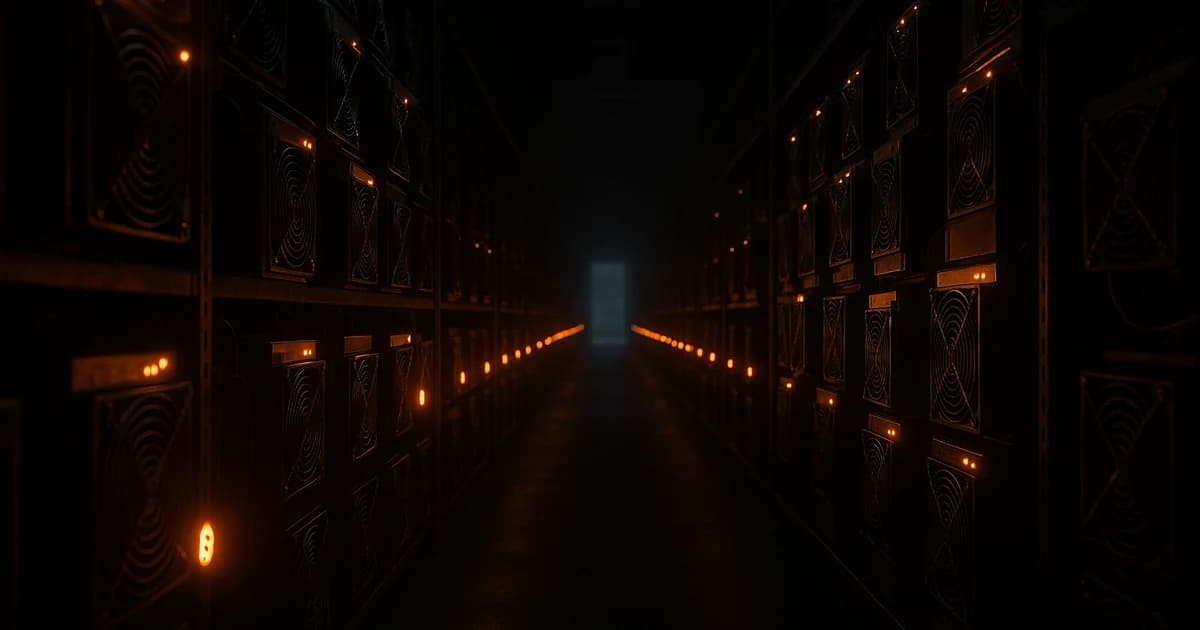
Miner hosting is simple to describe and easy to get wrong. You buy an ASIC miner. Instead of running it in your house, you ship it to a facility that has cheap industrial electricity, racks it, cools it, and keeps it online. You pay a rate per kilowatt-hour it consumes. The coins it mines go straight to your own wallet — the host never touches them.
That last point is the one that separates hosting from everything it gets confused with. You own the hardware. You keep 100% of what it produces. The host is a landlord for electricity and rack space, not a partner in your output.
This page explains how it works in practice, what it costs in 2026, and — the part most guides skip — the specific contract terms that decide whether a cheap rate is actually cheap. Figures current as of September 2026.
Why hosting exists at all
One number. A modern 13.5 J/TH miner breaks even at roughly $0.12 per kWh. The EU household electricity average is €0.2896 — about $0.337. Running that machine at home in Europe loses money every hour it is switched on, and no amount of efficiency shopping closes a three-fold gap.
Hosting solves the only variable that matters. Facilities are built where power is stranded or surplus — hydro that would otherwise spill, flared gas, geothermal in grids with no transmission capacity to move it. That electricity is near-worthless to the generator and transformative to a miner.
The secondary benefits are real but secondary: a full-size ASIC runs at 75 dB and dumps 3,500 W of heat into whatever room it occupies. Our apartment mining guide covers why that is usually a non-starter in a home, and the home versus hosted comparison runs both sides with numbers.
How it works, step by step
- You buy the miner. From us or anyone else — hosting and hardware are separable decisions, though buying both together usually removes a shipping leg.
- It ships to the facility, not to you. Where you buy and host in one place it goes direct, which avoids import duty in your own country and a second freight charge.
- The facility racks and commissions it — power, network, cooling, firmware check, pool configuration.
- You point it at your own pool and wallet. This is the step that defines hosting: you control the pool credentials, so mined coins are paid by the pool directly to you. The host never custodies your Bitcoin.
- You pay for the electricity it consumes, usually monthly in advance, at the agreed per-kWh rate.
- You monitor it remotely and the host handles physical maintenance — cleaning, fan replacement, re-seating boards.
Our own hosted machines appear in your dashboard with status, uptime and estimated earnings, and controls to pause, resume or change pool once the order is settled.
What hosting costs in 2026
| Who | Rate per kWh | What it is |
|---|---|---|
| Riot Platforms (Q2 2026, SEC filing) | $0.036 | Own sites, gigawatt scale, after grid credits |
| MARA (Q2 2026) | ~$0.04 | Own sites |
| US retail colocation, competitive | $0.065–0.08 | All-in, retail customers |
| US retail colocation, typical range | $0.06–0.09 | Varies by region and term |
| Hydro-rich regions (Paraguay, Québec) | $0.03–0.05 | Hosted all-in |
| EU industrial grid average (Eurostat) | €0.1837 (~$0.21) | Tariff, before any hosting margin |
Two things worth absorbing. Retail hosting costs roughly double what a gigawatt-scale operator pays — that gap is the host's margin, overhead and risk, and it is a legitimate price for not building your own substation. And European grid power is not competitive at any tier: even the EU industrial average sits well above the break-even for current hardware. Our hosting rate benchmark has the full comparison, and the cost breakdown covers how bills are actually structured.
The terms that decide whether a rate is real
Two hosts quoting "$0.07/kWh" can bill very differently. Before comparing anything, establish which of these sit inside the number:
- Meter basis. Are you billed on machine draw or facility draw? Heavy cooling can add 5–10% overhead.
- Management fee. Sometimes folded into the kWh rate, sometimes a separate per-machine monthly charge, sometimes a percentage of output.
- Repairs. Some hosts include labour and bill parts; some bill both; some simply unplug a dead machine and tell you later.
- Curtailment credits. In Texas especially, hosts earn money shutting machines off during grid stress. Whether that flows to you, to them, or is split is one of the largest variables in any contract and is almost never on the pricing page.
- Setup and deposit. A per-miner onboarding fee plus typically two to three months of power as security is standard — working capital you do not see again until you leave.
- Uptime. Ask for last year's actual figure by month, not the SLA number. Our SLA guide covers what a defensible guarantee looks like.
The clean test: ask for the total monthly cost for one specific machine, including every fee, then divide by that machine's expected kWh (watts × 24 × 30 ÷ 1,000). That gives the real effective rate, and it is the only number worth comparing.
Hosting is not cloud mining
These get conflated constantly, and the difference is the whole point.
| Hosting | Cloud mining | |
|---|---|---|
| What you own | A physical machine, identified by serial number | A contract |
| Where coins go | Your pool, your wallet, directly | The provider pays you |
| If the provider fails | You still own hardware | You own a claim |
| Can you verify it exists? | Yes — serial, rack, pool hashrate | Usually not |
| Exit | Ship the machine elsewhere | Contract ends |
Cloud mining sells you an entry in someone's database. Hosting puts a serial-numbered asset you own into a building. That difference is why cloud mining attracts fraud at a rate hosting does not — our cloud mining scams guide documents the enforcement record, and the direct comparison covers the rest.
The risk hosting does carry
Your hardware sits on someone else's balance-sheet risk, and the sector has a record here worth knowing. Compass Mining's 2022 dispute over its Maine facility left customer machines inaccessible while a commercial argument played out. Core Scientific's Chapter 11 forced hosting customers to negotiate as creditors. Neither was a marginal operator.
What to insist on, in writing, before shipping anything:
- Serial-number-level records identifying your specific machines as your property, not fungible inventory.
- A stated insolvency position — whether your hardware is segregated customer property or part of the estate.
- Defined exit terms — notice period, de-racking cost, who arranges shipping, how long it takes.
- What happens on arrears. Most contracts permit powering down and eventually selling your machine to recover unpaid bills. Know the threshold before you need to.
None of these are unusual asks. A host that resists all four is answering the question for you. Our contracts guide goes clause by clause.
Is hosting right for you?
Yes, if you want to own mining hardware but your electricity costs more than about 10 cents per kWh, you cannot accommodate 75 dB and 3.5 kW of heat, or you simply do not want to be the person replacing fans at midnight. That covers most individual buyers in the UK and Europe.
No, if you have genuinely cheap power and somewhere suitable to put a machine — at which point hosting's margin is a cost you do not need to pay. Or if you want the hardware physically with you, which is a legitimate preference and worth the money it costs.
Reconsider entirely if the plan only works at a rate you have been quoted but not verified. Run the effective rate — total monthly cost divided by expected kWh — through our profitability model against the machine you are actually considering. If it only works at the headline rate and not the all-in rate, that is your answer.
For the deeper dives: how to evaluate providers, which countries have the cheapest power, and business-scale colocation. Our own facilities and current rates are on the hosting page.
Sources: Riot Platforms and MARA Holdings Q2 2026 SEC filings for operator power costs; Eurostat household and non-household electricity prices H2 2025 (dataset nrg_pc_205); published 2026 rate guidance from US hosting providers; public reporting on the Compass Mining Maine dispute and Core Scientific's Chapter 11. Hosting rates change with capacity, contract term and power agreements — treat all figures as benchmarks rather than quotes. Mining income is never guaranteed.