

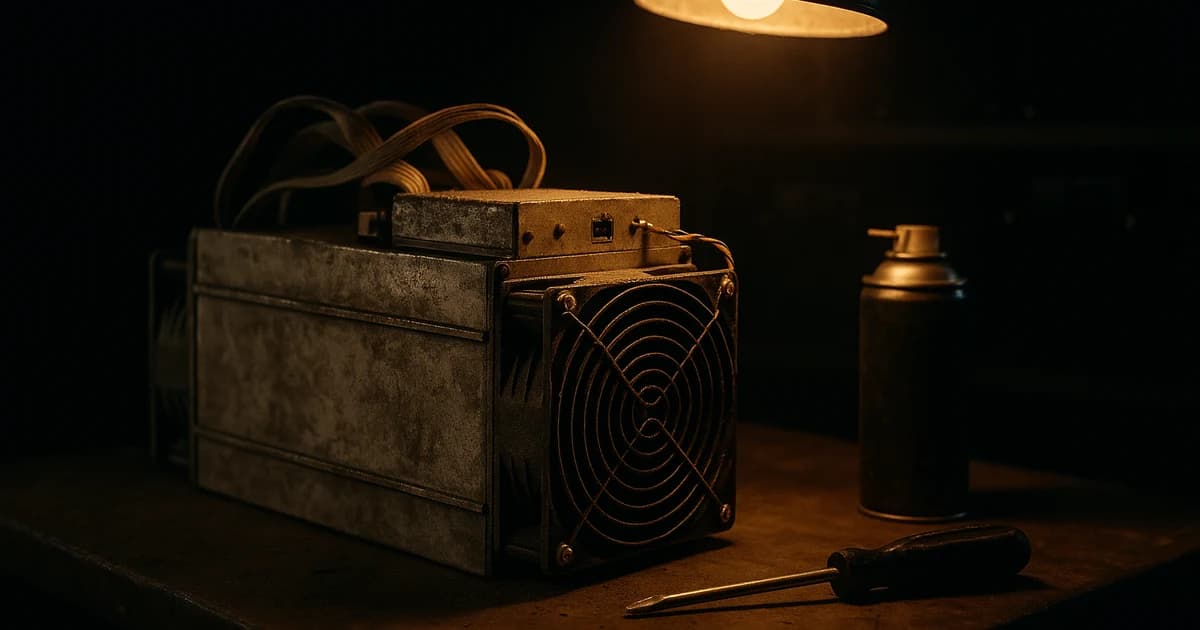
The used ASIC market runs on one strange fact: the same machine is simultaneously worth something and worth nothing, depending entirely on where it will be plugged in.
An Antminer S19j Pro is scrap at European power prices and a working asset at three cents a kilowatt-hour. The market prices this honestly — old hardware trades at about $1 per terahash against $18 for current machines — and the question for a buyer is never "is this cheap?" It always is. The question is whether your electricity rate is below the machine's break-even, and whether the specific unit in front of you actually still runs at spec.
This page covers both halves: what the old models are genuinely worth in 2026, model by model, and how to avoid buying one of the many that are quietly broken. Checked 13 September 2026.
The two-tier market in one table
Hashrate Index tracks ASIC prices by efficiency class. As of the start of September:
| Tier | Price per TH | What lives there |
|---|---|---|
| Under 14 J/TH | $18.38 | S21 family, S23, M70s, A16, SealMiner A3/A4 |
| 25–38 J/TH | $1.01 | S19, S19j Pro, M30S, M50 — the 2020–2022 fleet |
An eighteen-fold gap. It exists because buyers price megawatt-hours of margin, not terahashes: a sub-14 J/TH fleet currently earns about $136 per MWh of electricity it consumes, while the 25–38 J/TH fleet earns about $51 per MWh. The old machine only makes sense where power costs meaningfully less than 5 cents — which is why institutional sellers dump them by the pallet, and why they flow to buyers with stranded hydro and flared gas.
What the models people actually search for are worth
Gross revenue at the current network rate of 49.1 sats (≈$0.039) per TH/s per day; break-even is revenue divided by daily kWh.
| Machine | Era | Spec | Revenue/day | Break-even $/kWh | Verdict |
|---|---|---|---|---|---|
| Antminer S9 | 2016–18 | 13.5 Th/s, 1,323 W | $0.53 | $0.017 | Heater or lottery only |
| WhatsMiner M10S | 2018 | 33 Th/s, 2,145 W | $1.30 | $0.025 | Effectively e-waste |
| Antminer S19 | 2020 | 95 Th/s, 3,250 W | $3.74 | $0.048 | Sub-5¢ power only |
| Antminer S19j Pro | 2021 | 104 Th/s, 3,068 W | $4.10 | $0.056 | Marginal, cheap-power only |
| WhatsMiner M50 | 2022 | 114 Th/s, 3,276 W | $4.49 | $0.057 | Marginal |
| Antminer S19 XP | 2022 | 141 Th/s, 3,010 W | $5.56 | $0.077 | Workable at hosted rates |
| Antminer T21 | 2023 | 190 Th/s, 3,610 W | $7.49 | $0.086 | The value pick |
| Antminer S19k Pro | 2023 | 136 Th/s, 2,760 W | $5.36 | $0.081 | Workable |
Three answers to three common searches, directly:
The Antminer S9 is not a miner any more. At a 1.7-cent break-even it loses money on the cheapest industrial power on earth. Its two honest afterlives are as a ~1.3 kW space heater — the same displacement logic as our Bitcoin heater guide — and as nostalgia. If someone sells you one "for profit," reread our guide to dubious sellers.
The WhatsMiner M10S has no economic case at all — 65 J/TH is five times the current fleet average, and no power price rescues it that wouldn't earn triple running anything newer in the same socket.
The Obelisk SC1, which people still ask about, was a 2018 Siacoin machine from a company that no longer exists. There is no support, no parts and effectively no Siacoin ASIC economy left around it — collector value only. Old altcoin hardware generally ages worse than old Bitcoin hardware because the coin can die before the silicon does; our Innosilicon guide walks through exactly that with the A5, A8 and A10, and Bitdeer's first-generation SealMiner A1 has been so thoroughly superseded by the A3 and A4 that it barely trades.
The deadline that changes used-hardware maths: April 2028
Every break-even in the table above halves at the halving. An S19j Pro's $0.056 becomes $0.028. A T21's $0.086 becomes $0.043. Riot Platforms — gigawatt scale, demand-response credits, the best power deal in the industry — pays 3.6 cents.
The rule that follows is simple and worth writing down: a used machine must fully repay its price before April 2028, because its value on the other side of that date rounds to zero for anything over ~20 J/TH. Nineteen months. A $1,300 T21 netting $3.60/day at 4.5-cent power repays in about twelve — fine. The same machine at 7-cent power nets $1.44/day and repays in thirty — that purchase fails the test before you've opened the box. Full arithmetic in our halving guide.
Why "fully functional" used miners often aren't
The economics above assume a machine running at spec. Repair shops that process thousands of used units report the same failure patterns over and over, and none of them are visible in a marketplace photo:
- Degraded hashboards. Heat accelerates electromigration in the chips; a machine sold as 100 Th/s can genuinely deliver 72. The fans spin, the LEDs blink, the seller may not even know. Only a sustained hashrate log reveals it.
- Cooked thermal interface. Thermal paste is spent after 12–18 months of continuous load — refurbishers routinely find it turned to powder, insulating the very chips it should be cooling.
- Tampered firmware. Modified firmware can skim a hidden percentage of hashrate to someone else's wallet while your dashboard looks normal. Reflash stock firmware from the manufacturer's site before a used machine ever touches your pool — our firmware and tools guide covers how.
- Dying PSUs. Degraded capacitors deliver unstable voltage that slowly damages boards before failing outright. A J-code on an Antminer reads like a dead hashboard but is frequently the power supply — swap the cheap part first.
How to buy used without getting burned
- Demand a 24-hour pool screenshot, not a photo of blinking lights. Average hashrate, rejection rate and per-board temperatures. A single peak-hashrate screenshot means nothing. No log, no deal.
- Price in the true landed cost. Shipping runs $50–150 per unit each way; hashboard repair $100–500; a proper PSU if it ships without one. A "cheap" broken unit routinely ends up costing more than a tested one.
- Burn it in for 72 hours before trusting it. Intermittent faults surface at hour 30, not minute 30. Watch hardware errors and per-board hashrate the whole way.
- Reflash, inspect, sniff. Stock firmware first; then check connectors for burn marks, heatsinks for compacted dust — and yes, smell it. Burned electronics announce themselves.
- Prefer tested-and-warrantied over private-sale cheap. A refurbisher's 30-day warranty is worth a meaningful premium on hardware where the failure modes are invisible. Our own used and refurbished listings state condition and warranty explicitly — hold us to the same standard.
Who should actually buy old hardware
Buyers with genuinely cheap power — that is the entire list for profit-motivated purchases. At the sub-2-cent rates our hosting facilities run, even an S19-class machine keeps a wide margin, and $1-per-terahash hardware paired with cheap hosted power is the highest-ROI-percentage play in mining — provided it repays before April 2028.
Heat-seekers and hobbyists buy S9s for the winter and the history, with clear eyes about the arithmetic. Everyone else is better served by the middle tier — T21, S19k Pro, S19 XP — where break-evens near 8 cents survive normal hosting rates and the price per terahash is still a tenth of the flagship tier, or by reading our guide to why new prices fell before assuming used is the only affordable route.
Whatever you consider, run it through the profitability model at your real power price — and then check the machine's age against our guide on how long ASICs actually last, because a 2021 machine has already spent most of its life.
Sources: Hashrate Index ASIC Price Index by efficiency tier and energy-hashprice split, early September 2026; on-chain network data via mempool.space for the 49.1 sats/TH/day revenue rate; published refurbisher diagnostics and pricing (including D-Central Technologies' repair-lab reporting, reviewed February 2026) for failure patterns, repair costs and refurbished S19j Pro pricing; Riot Platforms Q2 2026 SEC filing for the 3.6¢/kWh benchmark; CoinShares Q1 2026 for fleet-underwater estimates. Break-evens assume current difficulty and Bitcoin price and move with both. Mining income is never guaranteed.