

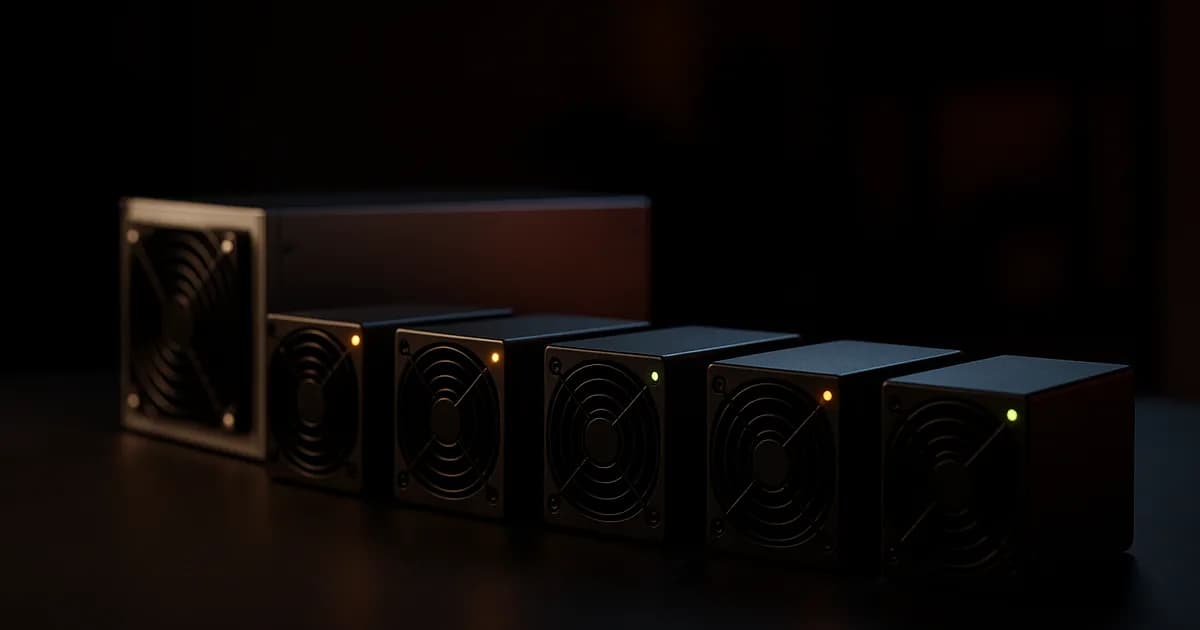
Goldshell occupies a corner of the ASIC market that almost nobody else bothers with: miners you can actually live with. While Bitmain and MicroBT build 3.5 kW machines that scream at 75 dB, Goldshell sells boxes the size of a hardback book that run at 35 dB and plug into a normal wall socket. It also covers more coins than any other single manufacturer — Kaspa, Alephium, Aleo, Litecoin and Dogecoin all from one vendor.
That breadth comes with a trade-off, and this guide is honest about it. Goldshell does not win on efficiency, and at August 2026 coin prices most of the range does not pay for itself. Here is the complete 2026 line-up, what each model actually earns, and the three that are genuinely worth buying.
What Goldshell is, and who its miners are for
Goldshell is a Chinese ASIC manufacturer that built its reputation on small-form-factor, low-noise miners for home and office use. Where Bitmain runs a single flagship line per algorithm, Goldshell spreads across six or more coins simultaneously, usually entering a market shortly after a new proof-of-work chain gains traction.
The pitch is specific: 35–45 dB operation, chassis that fit on a desk, wide-voltage 110–240 V input, single-Ethernet setup and a mobile app. If the machine is going to live in your home, that matters more than a J/Gh figure on a spec sheet. If it is going into a data centre where only efficiency counts, Goldshell is the wrong purchase — and we say which brands to buy instead further down.
Goldshell model names decoded: BOX, LITE, MAX, ECHO and BYTE
Goldshell's naming is more logical than it first appears. Every model name has two parts — a coin prefix and a form-factor series.
The first letters tell you the coin: KA is Kaspa (kHeavyHash), AL is Alephium (Blake3), AE is Aleo (zkSNARK), and DG or Mini-DOGE is Scrypt for Litecoin and Dogecoin. Goldshell also ships XT (Tari) and KD (Kadena) units.
The series name tells you the form factor:
| Series | Positioning | Noise | Examples |
|---|---|---|---|
| BOX | Compact entry tier, wide-voltage, home use | 35 dB | AL-BOX III, AE-BOX Pro |
| LITE | Denser home tier | 55 dB | — |
| MAX | High-hashrate professional tier | 55–85 dB | AL Max, AE Max, DG Max |
| ECHO (E-) | Quiet 3U rack format, PSU built in | 45 dB | E-KA1M, E-AL1M, E-DG1M |
| BYTE | Swappable coin cards | — | Byte |
One buying gotcha worth knowing before you order. LITE, MAX and ECHO models all ship with a power supply. BOX-series models only include one if the word "Plus" appears in the name. So the AL-BOX II Plus arrives ready to run, while the AL-BOX III and AE-BOX Pro need a PSU you supply separately. Roman numerals (II, III) simply denote generation.
The full 2026 Goldshell range compared
All specifications below are the manufacturer's rated figures, cross-checked against ASIC Miner Value listings as of 5 August 2026.
| Model | Coin | Hashrate | Power | Efficiency | Noise | Price |
|---|---|---|---|---|---|---|
| DG Max | LTC / DOGE | 6.5 Gh/s | 3,400 W | 0.523 J/Mh | 70 dB | $1,573 |
| E-DG1M | LTC / DOGE | 3.4 Gh/s | 1,800 W | 0.529 J/Mh | 45 dB | $703 |
| E-KA1M | Kaspa | 5.5 Th/s | 1,800 W | 0.327 J/Gh | 45 dB | $1,029 |
| AL Max | Alephium | 8.3 Th/s | 3,350 W | 0.404 J/Gh | 55 dB | $1,887 |
| E-AL1M | Alephium | 4.4 Th/s | 1,800 W | 0.409 J/Gh | 45 dB | $1,614 |
| AL-BOX III | Alephium | 1.25 Th/s | 600 W | 0.48 J/Gh | 35 dB | $760 |
| AL-BOX II Plus | Alephium | 1 Th/s | 480 W | 0.48 J/Gh | 35 dB | $615 |
| AE Max II | Aleo | 540 Mh/s | 3,200 W | 5.93 J/Mh | 85 dB | $884 |
| AE Max | Aleo | 360 Mh/s | 3,300 W | 9.17 J/Mh | 85 dB | $948 |
| E-AE1M | Aleo | 230 Mh/s | 2,000 W | 8.70 J/Mh | 45 dB | $637 |
| AE-BOX Pro | Aleo | 44 Mh/s | 460 W | 10.45 J/Mh | 35 dB | $684 |
The ECHO chassis measures 443 × 360 × 135 mm and weighs 16 kg; a BOX unit is 198 × 150 × ~90 mm and 2–4 kg. The AE Max II, released August 2025, is the newest model in the current range.
Goldshell Dogecoin and Litecoin miners: the DG range
The Scrypt models are the strongest part of the line-up, and it is worth understanding why. Litecoin and Dogecoin share the Scrypt algorithm, and since 2014 Dogecoin has accepted merge-mined blocks from Litecoin miners. One machine, one electricity bill, two coins credited simultaneously — you simply point it at a merge-mining pool.
At current prices Dogecoin supplies roughly 87% of that combined revenue and Litecoin about 13%, so a DG-series buyer is taking mostly DOGE price exposure. The DG Max (6.5 Gh/s) is the highest-output Scrypt unit Goldshell makes, while the E-DG1M delivers 3.4 Gh/s at 45 dB in a rack chassis — half the output, but far quieter and less than half the price.
For the wider Scrypt market, including Bitmain's L-series and ElphaPex, see our Dogecoin miner buyer's guide.
Goldshell Kaspa and Alephium miners
The E-KA1M is Goldshell's only current Kaspa unit: 5.5 Th/s at 1,800 W in the quiet 45 dB ECHO chassis. At 0.327 J/Gh it is roughly four times less efficient than Bitmain's KS7, so buy it for silence and KAS accumulation rather than yield.
Alephium is Goldshell's deepest range. The AL Max offers the best hashrate-per-dollar at $227/Th and the best efficiency in the family, but 3,350 W and 55 dB make it a hosting machine. At the other end, the AL-BOX II Plus draws just 480 W at 35 dB and includes its PSU — the easiest way into Alephium mining. For the alternative, see our IceRiver range guide.
Goldshell Aleo miners
Aleo is a zkSNARK proof-of-work chain, and Goldshell is one of the few manufacturers building for it. The AE Max II is by far the most efficient of the four at 5.93 J/Mh, against 8.7–10.45 J/Mh for the older units.
Be aware that Aleo revenue data is the least reliable in this category — different trackers report ALEO prices that differ by a factor of two, and the vendor-reported "Mh/s" unit is not standardised across manufacturers. What is not in dispute is the direction: at every electricity price we modelled, every Goldshell Aleo miner runs at a loss today. Buying one is a bet on the ALEO price recovering, not a cashflow decision. Treat it accordingly.
Real profitability: $0.02/kWh hosted vs $0.10/kWh at home
Figures below use coin prices on 5 August 2026 (KAS $0.0262, ALPH $0.0372, DOGE $0.0698, LTC $44.86) and assume 24-hour operation at rated hashrate, before pool fees and hardware costs. Coin prices and difficulty both move; treat these as a snapshot, not a forecast.
| Model | Revenue/day | Net @ $0.02/kWh | Net @ $0.10/kWh |
|---|---|---|---|
| DG Max | $3.11 | +$1.48 | −$5.05 |
| E-DG1M | $1.63 | +$0.77 | −$2.69 |
| E-KA1M | $0.89 | +$0.03 | −$3.43 |
| AL Max | $1.54 | −$0.07 | −$6.50 |
| AL-BOX III | $0.23 | −$0.06 | −$1.21 |
| AE Max II | ~$0.48–0.97 | −$0.57 to −$1.06 | −$6.71 to −$7.20 |
The honest summary: only the Scrypt line is clearly cash-positive today, and only on hosted-grade power. The E-KA1M sits on break-even at $0.02/kWh. Alephium and Aleo are negative even there. At $0.10/kWh domestic electricity, nothing in the Goldshell range makes money.
On payback at $0.02/kWh, the DG Max recovers its $1,573 in roughly 1,060 days and the E-DG1M its $703 in about 910 days. Run your own numbers on our mining calculator.
Goldshell vs IceRiver vs Bitmain
| Algorithm | Goldshell best | IceRiver best | Bitmain best |
|---|---|---|---|
| Kaspa | E-KA1M — 0.327 J/Gh | KS7 Lite — 0.119 J/Gh | KS7 — 0.077 J/Gh |
| Alephium | AL Max — 0.404 J/Gh | AL3 — 0.233 J/Gh | no ALPH miner |
| Scrypt | DG Max — 0.523 J/Mh | no Scrypt miner | L11 Pro — 0.172 J/Mh |
Bitmain wins raw efficiency on every algorithm it competes in — the KS7 is over four times more efficient than the E-KA1M — but its machines are loud, 3–4 kW, and built for data centres. IceRiver owns the middle ground with roughly double Goldshell's efficiency on Kaspa and Alephium while still offering genuinely small units.
Goldshell's wins are elsewhere: noise (35–45 dB against 70–85 dB), physical size, wide-voltage input, and coin coverage no rival matches. The rule of thumb is simple — if the machine lives in your home, buy Goldshell; if it lives in a data centre, buy Bitmain or IceRiver. See the Bitmain Antminer range guide for the industrial side.
Which Goldshell miner should you buy?
- Best overall buy: E-DG1M ($703) — the best profit-per-dollar in the range, positive at hosted power, and quiet enough at 45 dB to ignore.
- Highest output: DG Max ($1,573) — 6.5 Gh/s and the largest daily margin of any Goldshell today.
- Cheapest way in: AL-BOX II Plus ($615) — 480 W, 35 dB, PSU included.
- Best Kaspa: E-KA1M ($1,029) — the only option, break-even on cheap power.
- Best Alephium at scale: AL Max ($1,887) — best $/Th and J/Gh in the family, hosting only.
- Best Aleo: AE Max II ($884) — clearly the most efficient Aleo unit, but loss-making at current ALEO prices.
Cheap power is the whole game
Every Goldshell in this guide is profitable at $0.02/kWh and loses money at $0.10/kWh. Host yours with us from $0.018/kWh — we run it in a low-cost-energy facility while you keep 100% of the coins.
Browse the full miner range, or compare against the wider market in our 2026 mining hardware market report. Prices and profitability figures are accurate as of 5 August 2026 and will move with coin prices and network difficulty.