

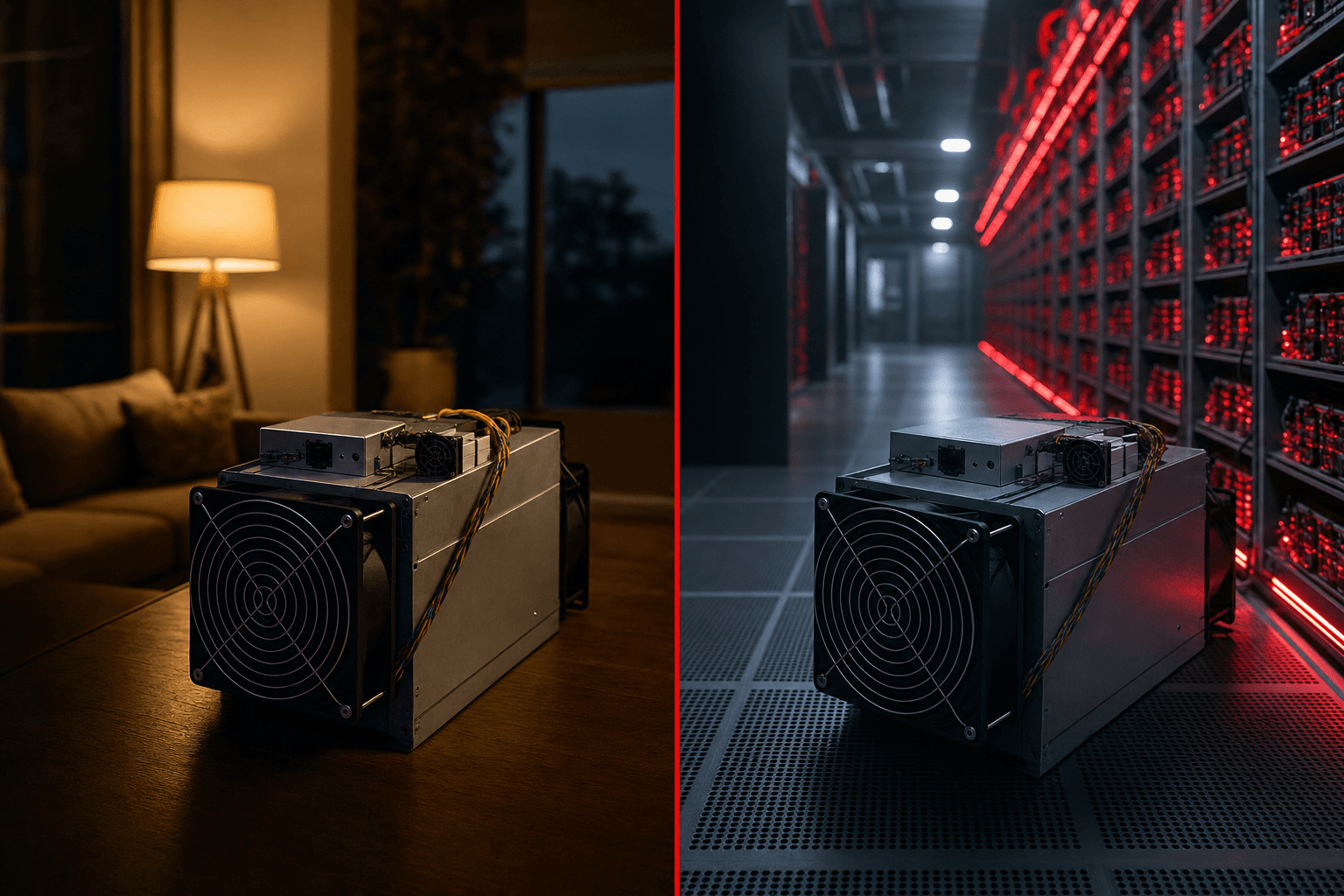
In 2026, hosting a miner is two to three times more profitable than running the same machine at home for most people in the UK and Europe. The reason is simple: home electricity costs $0.15–$0.30/kWh, while professional hosting runs $0.04–$0.08/kWh all-in. On a single ASIC that gap is the difference between a small profit and a monthly loss. Here’s the full comparison, with the real numbers.
“After the 2024 halving, home mining on residential power became a losing proposition for most hardware. Profitability now lives below roughly $0.10/kWh.” — 2026 industry analysis. Below that line you earn; above it, you subsidise the network.
The core trade-off
When you buy a miner you have two choices: plug it in at home, or send it to a hosting facility. You own the machine and keep the coins either way. What changes is your cost per kilowatt-hour, your uptime, and how much of your life the machine takes over.
Hosting vs home mining: side by side
| Mining at home | Hosting | |
|---|---|---|
| Electricity | $0.15–$0.30/kWh (residential) | $0.04–$0.08/kWh (industrial) |
| Uptime | ~85–95% (trips, heat, outages) | 98–99%+ (24/7 monitored) |
| Noise & heat | ~75 dB + space-heater output in your home | None — it’s in a data centre |
| Repairs | You DIY or wait 60–120 days for RMA | In-house, often 1–2 weeks |
| Setup hassle | Wiring, cooling, ventilation | Plug-and-play, racked for you |
| You own the miner? | Yes | Yes |
The numbers: a worked example
Take one 3.5 kW ASIC running 24/7 (~2,554 kWh/month):
- At home, $0.20/kWh: 2,554 × $0.20 = ~$511/month in power.
- Hosted, $0.07/kWh: 2,554 × $0.07 = ~$179/month all-in.
That’s a $332/month swing on a single machine — nearly $4,000 a year — before you even count the better uptime and faster repairs. If a miner earns, say, $350/month in Bitcoin at current difficulty, the home setup barely breaks even while the hosted one nets ~$170. See the full maths in our hosting cost breakdown.
Stop subsidising your home electricity bill. Host the exact same miner with Bull Miners from $0.02/kWh, keep 100% of the coins, and lose the noise and heat. Estimate your net profit in the dashboard before you commit.
When does mining at home make sense?
Home mining isn’t always wrong. It can work if:
- Your electricity is genuinely cheap (under ~$0.10/kWh) — rare on residential tariffs.
- You can use the heat productively (heating a workshop, garage or pool).
- You run a small, efficient unit like a Bitaxe or Lucky Miner for the hobby, not the profit. Our best miner buyer’s guide covers low-power options.
For a full-size ASIC aimed at profit, though, the power-cost gap almost always points to hosting.
The hidden costs people forget at home
- Cooling and electrical work — proper ventilation or a dedicated circuit can run into the hundreds.
- Downtime — every breaker trip or heat shutdown is lost revenue; home uptime rarely matches a monitored facility.
- Repair delays — a dead hashboard sent back to the manufacturer can sit idle for months. A good host swaps it in a week or two.
- Your sanity — 75 dB, 24 hours a day, is not a small thing.
Hosting isn’t cloud mining
To be clear: hosting still means you own the machine. It’s not the same as buying a cloud-mining contract, where you own nothing and trust an operator to pay. If you’re weighing those too, read hosted mining vs cloud mining. And if power price is your deciding factor, see which countries offer the cheapest mining electricity.
FAQ
Is it cheaper to host a miner or run it at home?
Hosting, in almost every case. Industrial power at $0.04–$0.08/kWh beats residential $0.15–$0.30/kWh by two to four times, which usually outweighs the hosting service fee.
Can I still mine profitably at home in 2026?
Only if your electricity is under ~$0.10/kWh or you reuse the heat. On standard UK/EU residential tariffs, most full-size miners lose money at home after the halving.
Do I keep the coins if I host?
Yes — 100% goes to your wallet. You pay a flat per-kWh hosting fee; the host never touches your rewards.
What about repairs if my miner is hosted?
Good hosts repair in-house, often within 1–2 weeks, versus 60–120 days for a manufacturer RMA you’d manage yourself at home.
Related reading
- Best Bitcoin Mining Hosting Companies in 2026 (Compared)
- Best Countries to Mine Crypto in 2026
- Crypto Mining Hosting Cost 2026: Per-kWh, Fees & ROI
- Bitcoin Mining Hosting: How It Works & Costs
Run the same miner for a fraction of the power cost. Start hosting with Bull Miners →