

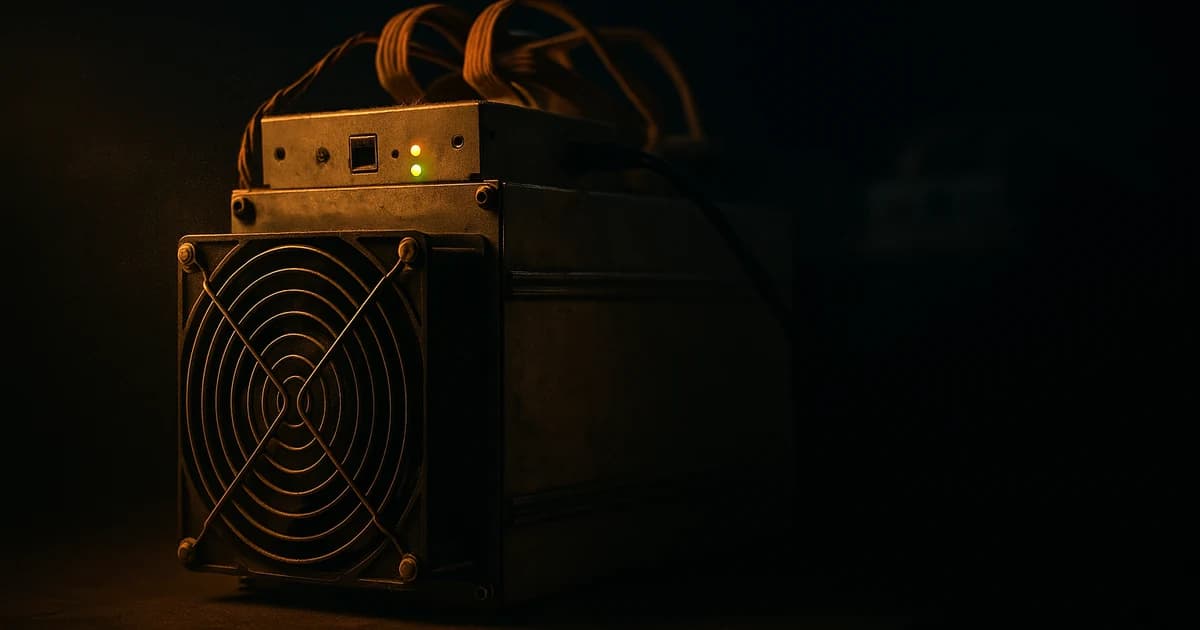
Innosilicon is the manufacturer nobody writes about any more, which is a shame, because one of its machines is currently the fastest-paying ASIC in our entire catalogue on a payback basis — and it costs $595.
That is not a typo and it is not a permanent condition. It is the product of an unusual moment: Zcash has more than doubled in the last month, Equihash hardware has been written off by almost everyone, and the second-hand price of an A9++ ZMaster has not caught up. This page explains what Innosilicon still makes, which units make sense, and — bluntly — which one is dead. Figures checked 9 September 2026.
Who Innosilicon are
Innosilicon is a Chinese fabless semiconductor company that was, for a period around 2018–2021, Bitmain's most credible competitor. It shipped ASICs across an unusually wide spread of algorithms — Equihash, Scrypt, Ethash, X11, Blake — under the ZMaster, LTCMaster, DashMaster and A-series names.
It has since largely exited merchant mining hardware. Its semiconductor IP business continues; its miner line does not have a current-generation product. What that means for a buyer is straightforward and worth stating plainly: everything below is legacy hardware. There is no roadmap, no new firmware pipeline, and support is whatever your seller offers. Buy accordingly — and read that alongside our note on what is actually shipping in 2026, where Auradine has just made the same exit.
The Zcash machines: the A9 ZMaster family
Zcash is having a year. Here is where the network actually stands.
| Metric | Value (9 Sep 2026) |
|---|---|
| ZEC price | $1,279 — up 51% on the day |
| Market capitalisation | $20.89 billion |
| 24-hour volume | $1.59 billion |
| Network hashrate | 25.82 Gh/s (Equihash) |
| Difficulty | 237.77M, down 1.7% |
| Block reward | 1.25 ZEC every 75 seconds |
| Revenue per kSol/s/day | $0.0709 |
Two things are unusual here. ZEC's thirty-day range was $472 to $855 — it is now trading well above the top of its own recent range. And network hashrate has fallen 10%, to 25.82 Gh/s, from a thirty-day high of 36.14 Gh/s. Rising price with falling hashrate is the single most favourable combination that can happen to a miner, and it is why the numbers below look the way they do.
It is also why you should not assume they persist. Hashrate follows profit with a lag of weeks. If ZEC holds these levels, machines will come back online and per-unit revenue will fall.
| Model | Hashrate | Power | Our price | Revenue/day | Profit/day at $0.08 | Break-even $/kWh |
|---|---|---|---|---|---|---|
| A9++ ZMaster | 140 kSol/s | 1,550 W | $595 | $9.94 | $6.96 | $0.267 |
| A9+ ZMaster | 120 kSol/s | 1,550 W | $1,761 | $8.52 | $5.55 | $0.229 |
| A9 ZMaster (original) | 50 kSol/s | ~1,250 W | — | $3.55 | $2.36 | ~$0.118 |
Look at the first two rows again. The A9++ is faster than the A9+, draws the same power, earns $1.42 more a day — and costs a third of the price. There is no version of this comparison where the A9+ wins. If you are buying an Innosilicon Zcash miner, buy the A9++.
The payback figures follow from that:
| Model | Cost | Profit/day at $0.08/kWh | Payback |
|---|---|---|---|
| A9++ ZMaster | $595 | $6.96 | ~2.8 months |
| A9+ ZMaster | $1,761 | $5.55 | ~10.5 months |
A 2.8-month payback is faster than anything in Bitcoin, where current-generation hardware runs seven months at hosted rates and ten at industrial. That gap exists because of risk, not because the market has missed something: Zcash is up 51% in a day, Equihash hardware is obsolete and unsupported, and a machine that pays back in three months at today's price pays back in nine if ZEC halves. Which it did, in the other direction, four weeks ago.
The 26.7-cent break-even is the more durable number, and it is genuinely good. It means the A9++ tolerates a large fall in ZEC before it stops covering its own electricity, and it stays viable on power prices that kill Bitcoin miners three times over. Our Zcash mining guide covers the coin side, including the proof-of-stake question that hangs over all of this.
Where the A9++ sits against Bitmain
Honestly: fourth.
| Machine | Revenue/day | Profit/day at $0.08 |
|---|---|---|
| Antminer Z15 Pro | $59.67 | $54.33 |
| Antminer Z15K | $37.29 | $32.53 |
| Antminer Z15 | $29.83 | $26.94 |
| Innosilicon A9++ ZMaster | $9.94 | $6.96 |
| Antminer Z11 | $9.59 | $6.87 |
| Innosilicon A9+ ZMaster | $8.52 | $5.55 |
Bitmain's Z15 line is comprehensively better hardware — the Z15 Pro earns nearly eight times the A9++'s daily profit. If you can buy a Z15 Pro at a sane price, buy that instead.
The case for the A9++ is entry cost. At $595 it is the cheapest way into Equihash by a wide margin, and the payback maths reflects that. It is a small position in a volatile market, not a fleet purchase.
The A4+ LTCMaster: do not buy this as a miner
We list the A4+ LTCMaster at $1,330 for 620 Mh/s of Scrypt at 750 W. Here is what it actually does.
| A4+ LTCMaster | |
|---|---|
| Revenue per day | $0.27 |
| Electricity per day at $0.08/kWh | $1.44 |
| Net per day | −$1.17 |
| Break-even electricity price | $0.015/kWh |
A break-even of one and a half cents per kilowatt-hour is below what Riot Platforms achieves at gigawatt scale after demand-response credits (3.6 cents, from its own SEC filing). There is no electricity rate available to a retail buyer, anywhere, hosted or otherwise, at which this machine makes money. Its efficiency is 1.21 J/Mh against 0.149 J/Mh for a current SealMiner DL1 — roughly eight times worse.
We keep it listed because collectors and tinkerers buy old hardware for reasons other than yield, and because being straight about it is more useful than quietly delisting. But it should not be bought as a mining investment. If you want Scrypt, our Scrypt guide covers what actually works, and the short version is that nothing in that market clears 11 cents either.
A note on our own profit estimates
While researching this page we found that our earnings model had no entry for Equihash or Etchash, which meant Zcash and Ethereum Classic machines were falling through to a generic fallback rather than being modelled from real network data. That is fixed — the figures on this page and on every Innosilicon, Jasminer, iPollo and Bombax product page are now derived from live coin economics.
We mention it because the site is full of profit numbers and you should know how they are produced. Every figure comes from the same model, with your electricity rate as an input, and none of it is a guarantee.
Which Innosilicon, if any
The A9++ ZMaster at $595 is the only one we would recommend, and only as a deliberately small, deliberately speculative position. The 2.8-month payback is real at today's ZEC price and will not survive a return to August levels; the 26.7-cent break-even is the number that gives it durability.
Skip the A9+. It is slower and three times the price for the same power draw.
Do not buy the A4+ LTCMaster to mine. It loses money at every retail electricity rate in the world.
And understand the general condition: this is unsupported legacy hardware from a manufacturer that has left the market. That is a reasonable bet at $595 with a three-month payback. It is not a reasonable bet at $1,761. If you want current hardware with a support path, our 2026 buyer's guide and upcoming miners page cover what is actually shipping.
As always, run your own electricity rate through the profitability model before buying, and if the answer only works at rates you cannot actually get, it is not an answer.
Sources: Minerstat ZEC network data, hardware rankings and pool table, read 9 September 2026 (ZEC $1,279.26, network 25.82 Gh/s, difficulty 237.77M, block reward 1.25 ZEC); Bull Miners earnings model at $0.0709 per kSol/s/day for Equihash and $0.4388 per Gh/s/day for Scrypt; Riot Platforms Q2 2026 SEC filing for the 3.6 c/kWh comparison. Revenue figures assume 100% uptime and no pool fee. Prices shown are our listed prices and change. Mining income is never guaranteed and moves with coin price and network difficulty — Zcash in particular has moved more than 50% in a single day this week.