

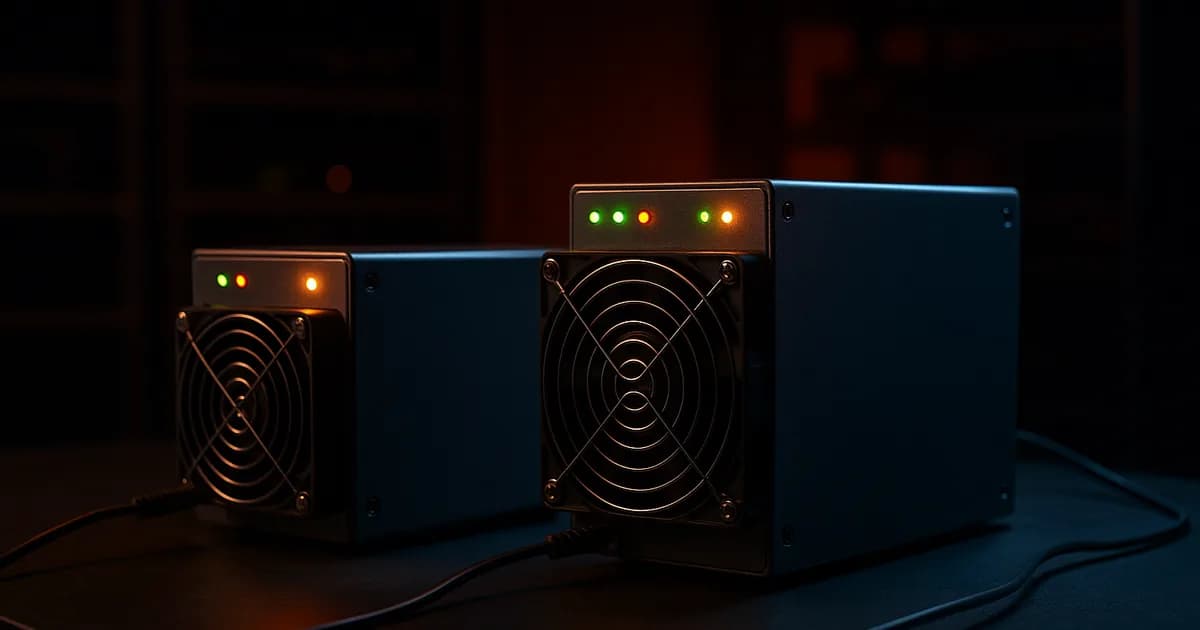
When Ethereum switched to proof-of-stake in September 2022, it stranded an enormous amount of Ethash mining hardware overnight. iPollo was one of only two manufacturers that kept building ASICs for the miners who moved to Ethereum Classic — the other being Jasminer.
Four years on, the range is mature and the company has visibly moved on to other things. This guide decodes the model names (including why the V2H is smaller than the V2, and why the "iPollo Pro" you may have seen listed does not exist), gives verified specifications for every model, and provides honest earnings maths for Ethereum Classic and Grin in 2026.
Who iPollo is, and where the brand stands in 2026
iPollo is the mining hardware brand of Nano Labs Ltd (Nasdaq: NA), a Chinese fabless chip design house. iPollo Pte. Ltd. was incorporated in Singapore in June 2021 as an indirect wholly-owned subsidiary, with R&D across Singapore, Hong Kong and Shanghai. This is a real silicon company with genuine design history, not a white-label reseller.
That said, the mining line is winding down, and you should know that before buying. The last genuinely new miner was the V2 series in November 2024 — around 21 months ago. On iPollo's own store the V2, V2H, G1 and B1L all show as sold out. The homepage now leads with the ClawPC A1 Mini, a $499 mini PC launched in March 2026. The company's centre of gravity has shifted from ASICs to consumer and edge computing.
Practically, that means: stock in the channel is what exists, warranties are short (the G1 product page states 180 days, and V2-era units typically carry 6–12 months depending on batch), and spare-part availability over a three-year hold is a real risk. iPollo does still run firmware pages, a serial-number warranty checker and a repair ticket system, so the support infrastructure exists — but buy from a stockist who will handle warranty locally.
iPollo model names decoded
| Prefix | Coin / algorithm | Status |
|---|---|---|
| V | Ethash / ETChash → Ethereum Classic | Main line. V1 generation 2022–23, V2 generation Nov 2024 |
| G | Cuckatoo32 → Grin | G1 (Dec 2020), G1 Mini (Jan 2021) |
| X | Ethash → ETC, home form factor | X1 only (330 Mh/s, 240 W) |
| B | SHA-256 → Bitcoin | B1L only — obsolete at ~50 J/Th |
Two naming points that cause real confusion:
"H" does not mean "high". The V1H (950 Mh/s) is the larger unit in its generation, but the V2H (3.4 Gh/s) is smaller than the V2 (10 Gh/s). H denotes a distinct chassis and tier within a generation, not a position in a hierarchy.
There is no iPollo "Pro". Every model in the catalogue has been checked and no Pro variant exists — "Pro" is a Jasminer and Bitmain convention. If you see an "iPollo V2 Pro" advertised, treat the listing as suspect.
Other suffixes: X as a suffix marks the entry unit of a generation (V2X, 1.2 Gh/s), Mini is the desktop form factor, Classic refers to Ethereum Classic, SE denotes an efficiency-tuned variant (the V1 Mini SE is genuinely better at 0.58 j/Mh versus 0.8), and Plus means roughly double the hashrate of the base sub-variant.
The full iPollo range in 2026
| Model | Coin | Hashrate | Power | Efficiency | Released |
|---|---|---|---|---|---|
| V2 | ETC | 10 Gh/s | 1,500 W | 0.15 j/Mh | Nov 2024 |
| V2H | ETC | 3.4 Gh/s | 475 W | 0.14 j/Mh | Nov 2024 |
| V2X | ETC | 1.2 Gh/s | 165 W | 0.138 j/Mh | Nov 2024 |
| V1 | ETC | 3.6 Gh/s | 3,100 W | 0.861 j/Mh | Jun 2022 |
| V1 Classic | ETC | 1.55 Gh/s | 1,240 W | 0.8 j/Mh | Jun 2022 |
| V1H | ETC | 950 Mh/s | 750 W | 0.789 j/Mh | Sep 2023 |
| V1 Mini SE Plus | ETC | 400 Mh/s | 232 W | 0.58 j/Mh | Aug 2022 |
| V1 Mini | ETC | 300 Mh/s | 240 W | 0.8 j/Mh | Jun 2022 |
| G1 | Grin | 36 h/s | 2,800 W | 77.8 j/GPS | Dec 2020 |
| G1 Mini | Grin | 1.2 h/s | 120 W | 100 j/GPS | Jan 2021 |
| B1L | Bitcoin | 60 Th/s | 3,000 W | 50 J/Th | Mar 2022 |
V1 vs V2: the most important fact in this guide
The jump from the V1 generation to the V2 generation was enormous. The V1 runs at 0.861 j/Mh; the V2 runs at 0.15 j/Mh. That is 5.7 times more efficient.
Put concretely: the V1 burns 3,100 W to produce 3.6 Gh/s. The V2H produces 3.4 Gh/s on 475 W. Near-identical output, a fraction over one seventh of the power. If you are choosing between a V1 and a V2 at similar prices, the V2 is not marginally better — it is a different class of machine.
What iPollo ETC miners actually earn
Ethereum Classic in early August 2026: ETC trades around $6.50 (sources range $6.47–$7.12, and a 9% intraday move was recorded on the day of writing), network hashrate sits near 155 Th/s, difficulty around 2.0–2.3 P, with a block time of 13.81 seconds and a block reward near 2.05 ETC following the reduction in July 2026.
Figures below assume ETC at $6.50, a yield of 0.0625 ETC per Gh/s per day, 100% uptime, and exclude pool fees and hosting costs. A first-principles calculation from network statistics gives 20–30% higher yield, so treat everything here as ±25%.
| Model | Gross/day | Net @ $0.02/kWh | Net @ $0.10/kWh | Break-even power |
|---|---|---|---|---|
| V1 (3.6 Gh/s) | $1.46 | −$0.03 | −$5.98 | $0.020/kWh |
| V2 (10 Gh/s) | $4.06 | +$3.34 | +$0.46 | $0.113/kWh |
| V2H (3.4 Gh/s) | $1.38 | +$1.15 | +$0.24 | $0.121/kWh |
The V2 pays back in roughly 3.3 years at $0.02/kWh and effectively never at $0.10/kWh. The V1 does not pay back at any realistic European tariff — it breaks even at two cents, which is below almost every industrial rate available. Its only honest use cases are near-free or curtailed power, or as a heat source.
The broader point: every ETC ASIC on the market has a break-even electricity price between roughly 2 and 15 cents per kWh. Outside cheap industrial or hosted power, Ethereum Classic mining loses money in 2026. Run your own numbers on the mining calculator.
The G1 and Grin: read this before you buy
The iPollo G1 is a Grin miner running Cuckatoo32 at 36 h/s and 2,800 W. It is not an Ethereum Classic miner, despite frequently being listed alongside the V-series.
Grin itself is genuinely interesting: a MimbleWimble privacy coin launched in January 2019 with no ICO, no pre-mine and no founder reward — one of the purest fair launches in the industry. There is no company and no foundation. Emission is constant and infinite by design: one GRIN per second, forever.
And here is the problem, stated plainly. Grin trades around $0.0145 with a market cap near $3.4M. Its total global 24-hour trading volume is under $1,000, on a single exchange, with roughly $9 of order-book depth within 2% of spot. It set an all-time low ten days before this was written and is down about 99.9% from its 2019 peak.
A single G1 mines somewhere between $5 and $12 of GRIN per day depending on whose figures you use. That is several days of the entire market's trading volume, every day. You cannot sell a G1's output at the quoted price. Profitability calculators showing the G1 in green are arithmetically correct and practically meaningless — they multiply a coin count by a price with no liquidity behind it.
We stock the G1 at $5,096, well below the $5,995 market reference and far below iPollo's own list price. But we will not present it as an investment. Buy it if you want Cuckatoo32 hashpower for its own sake, want to support the network, or are mining to hold indefinitely. Do not buy it expecting to sell the output.
iPollo vs Jasminer for Ethereum Classic
| iPollo V2 | iPollo V1 | Jasminer X44-P | |
|---|---|---|---|
| Hashrate | 10 Gh/s | 3.6 Gh/s | 23.4 Gh/s |
| Efficiency | 0.15 j/Mh | 0.861 j/Mh | 0.109 j/Mh |
| Price | $3,997 | $3,144 | ~$9,075 |
| $ per Gh/s | $400 | $873 | $479 |
| Break-even power | $0.113/kWh | $0.020/kWh | $0.155/kWh |
The Jasminer X44-P wins on the metric that decides survival. At 0.109 j/Mh it tolerates power up to about 15.5 cents; the V2 taps out at 11.3. That four-cent gap is the difference between running through a bad market and switching the machine off.
The iPollo V2 wins on capital efficiency. At $400 per Gh/s it beats the X44-P's $479, and the entry ticket is under half. If you are capital-constrained, starting small, or spreading risk across more units, the V2 is the rational buy.
For the full head-to-head across every ETC machine, see our Ethereum Classic miner comparison.
Which iPollo is right for you?
- iPollo V2 ($3,997) — the sensible choice. Buy if you have hosted or industrial power below about 8c/kWh, want ETC exposure without a five-figure Jasminer outlay, and value the best price-per-gigahash in the range.
- iPollo V1 ($3,144) — only with near-free, curtailed or surplus power, or if you want a space heater that partly pays for itself. At a similar price the V2 is the better machine, and we would rather say so.
- iPollo G1 ($5,096) — only if you specifically want Grin hashpower and understand the liquidity position described above.
- Avoid iPollo entirely if you are on a UK or EU domestic tariff (every model loses money at 25–35p/kWh), you need a multi-year warranty and guaranteed spares, or you want maximum ETC hashrate per rack unit — in which case buy the Jasminer.
Every iPollo needs cheap power to work
The V2 breaks even at 11c/kWh, the V1 at 2c. On a domestic tariff neither profits. Host with us from $0.018/kWh and keep 100% of the coins.
Browse the full miner range or compare the wider market in our 2026 hardware market report. Prices and network data accurate as of 5 August 2026; ETC and GRIN are both volatile, so re-check before committing.