

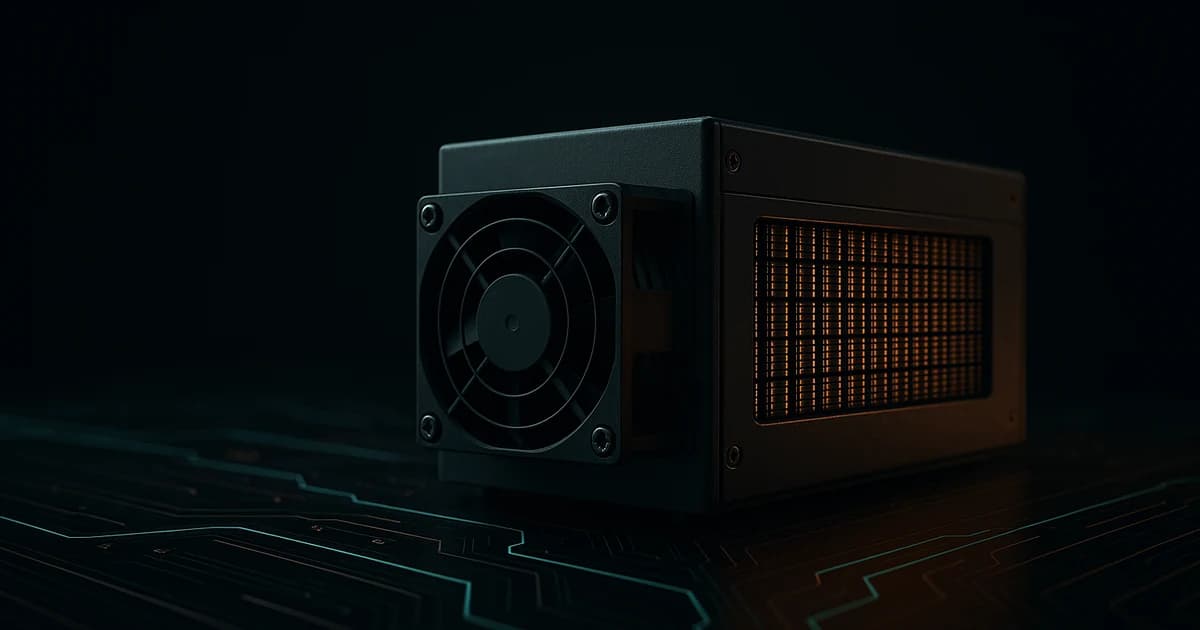
Jasminer occupies an odd position in mining hardware. It makes the most profitable ASIC in its category by a factor of nearly two — and almost nobody outside Ethereum Classic mining has heard of it, because the category itself is a leftover.
When Ethereum moved to proof of stake in September 2022, an entire generation of Ethash hardware lost its market overnight. Most of it went to scrap. Ethereum Classic is what remains: the same algorithm family, a real chain, a $1.3 billion market cap — and the only meaningful place left to point an Ethash machine. Jasminer builds for it.
This page covers the current X-series with real numbers pulled 9 September 2026, and is honest about which models still work and which do not. If you want the cross-brand comparison including iPollo and Bombax, that is our best ETC miner guide; this one is about Jasminer specifically.
Where Ethereum Classic actually stands
| Metric | Value (9 Sep 2026) |
|---|---|
| ETC price | $8.30 (up 11% on the day) |
| Market capitalisation | $1.30 billion |
| 24-hour volume | $122 million |
| Network hashrate | 124.2 Th/s (Etchash) |
| Difficulty | 1.825 × 10¹⁵ |
| Block reward | 2.048 ETC every 15 seconds |
| Revenue per Gh/s/day | $0.805 |
The number to notice is the $122 million of daily volume. That is the difference between Ethereum Classic and most niche proof-of-work coins, and it is the reason a Jasminer is a defensible purchase where an equivalent machine for a $5-a-day-volume coin is not. You can actually sell what you mine, on Binance, OKX and Coinbase, at size, without moving the price.
Be aware of the volatility underneath, though. Over the last thirty days ETC has traded between $6.04 and $9.01 and network hashrate has swung from 117 to 201 Th/s. Your revenue per machine moves inversely with that hashrate, and it has been a 70% swing inside a month. Any single-day profitability figure — including the ones below — is a snapshot, not a run rate.
The Jasminer range, with real numbers
All figures at $0.08/kWh, which is a realistic hosted or good industrial rate.
| Model | Hashrate | Power | Efficiency | Revenue/day | Profit/day | Break-even $/kWh |
|---|---|---|---|---|---|---|
| X44-P | 23.4 Gh/s | 2,550 W | 109 W/Gh | $18.81 | $13.92 | $0.308 |
| X16-P | 5.8 Gh/s | 1,900 W | 328 W/Gh | $4.66 | $1.02 | $0.102 |
| X16-QE | 1.75 Gh/s | 550 W | 314 W/Gh | $1.41 | $0.35 | $0.107 |
| X16-Q Pro | ~2 Gh/s | ~620 W | ~310 W/Gh | $1.65 | $0.65 | ~$0.111 |
The X44-P is in a different league and it is not close. At 109 watts per gigahash it is three times more efficient than every other machine Jasminer makes, and that single fact drives everything else: it breaks even at 30.8 cents per kilowatt-hour, where the X16 series breaks even around 10 cents.
Thirty cents is an extraordinary figure in mining. It means the X44-P is one of the very few ASICs on the market that still makes money on European domestic electricity. Eurostat puts the EU household average at €0.2896/kWh — about $0.337 — so it is marginal there, but at UK or German industrial rates, or anywhere near $0.15, it is comfortably profitable. Compare that to a current-generation Bitcoin miner, which breaks even at about $0.122/kWh and is three times underwater at domestic prices.
Why the X44-P is so much better
Jasminer's design choice is unusual. Most Ethash hardware is built around large amounts of relatively slow memory, because Ethash is memory-hard by design — the algorithm was written specifically to resist ASICs by making the bottleneck memory bandwidth rather than raw compute. Jasminer went the other way and built what is effectively a server-grade memory subsystem, trading silicon area for bandwidth per watt.
The result is visible in the efficiency column above. The X16 series sits at roughly 310–330 W/Gh, which is in the same range as iPollo's and Bitmain's Ethash machines. The X44-P sits at 109. That is not an incremental improvement; it is a different architecture.
It also explains the price. The X44-P is our most expensive Jasminer at $9,075, against $2,012 for the X16-P. On a per-gigahash basis that is $388/Gh versus $347/Gh — actually similar. You are not paying a premium for hashrate. You are paying roughly the same for hashrate and getting the efficiency free, which makes the X16 series difficult to justify at any price unless your electricity is nearly free.
How it compares across the whole Ethash market
| Machine | Revenue/day | Profit/day at $0.08 |
|---|---|---|
| Jasminer X44-P | $18.81 | $13.92 |
| Bombax EZ100-Pro | $12.46 | $6.51 |
| Bombax EZ100 | $10.05 | $5.63 |
| iPollo V2 | $8.04 | $5.16 |
| Antminer E11 (9.5Gh) | $7.64 | $2.90 |
| iPollo V2H | $2.73 | $1.82 |
| Jasminer X16-P | $4.66 | $1.02 |
The X44-P earns more than twice the daily profit of the next-best machine on the market. That is a rare position for any manufacturer to hold in any algorithm, and it has held for a while.
One machine on this list deserves a warning. The iPollo V1 draws 3,100 W for 3.6 Gh/s — 861 W/Gh. It earns about $2.90 a day and costs $5.95 a day in electricity at $0.08/kWh. It breaks even at 3.9 cents per kilowatt-hour, which is below what Riot Platforms pays at gigawatt scale. There is essentially no rate at which a retail buyer can run one profitably. We list it because some buyers want the hardware for other reasons, but it should not be bought as a miner. Our iPollo guide covers that range in full.
Pools and payouts
ETC pool economics are notably better than Bitcoin's for a small miner, mostly because the payout thresholds are low relative to what the machines earn.
| Pool | Fee | Scheme | Minimum payout |
|---|---|---|---|
| Hiveon | 0% | PPS+ | 1 ETC |
| Pearpool | 0.50% | DPPLNS | 0.1 ETC |
| Kryptex | 1% | PPS+ | 0.002 ETC |
| Ethermine | 1% | PPLNS | 0.1 ETC |
| Cruxpool | 1% | PPS+ | 0.1 ETC |
| CrazyPool | 1% | DPPLNS | 0.01 ETC |
| F2Pool | 3% | PPS | 0.1 ETC |
| ViaBTC | 4% | PPS+ | 0.1 ETC |
An X44-P mines about 2.27 ETC a day, so it clears even Hiveon's 1 ETC minimum inside a day. Contrast that with Bitcoin, where a 200 Th/s machine takes six weeks to reach F2Pool's default threshold. The fee spread matters more here than the threshold: 4% at ViaBTC against 0% at Hiveon is roughly $275 a year on a single X44-P. Our pool guide explains what PPS, PPS+ and PPLNS actually mean for your income.
A useful benchmark from the same data: at current difficulty an X44-P mines one whole ETC in about eleven hours. Whether that is a good thing depends entirely on what you think ETC will be worth, which brings us to the risk.
The honest risks
Single-chain exposure. Etchash hardware mines Ethereum Classic and effectively nothing else of consequence. If ETC's security model or valuation changes, there is no second market to fall back on. Bitcoin miners have this problem too, but Bitcoin is not a chain that could plausibly change consensus mechanism — Ethereum already did exactly that to this hardware's original market.
Price volatility. ETC ranged from $6.04 to $9.01 in thirty days, a 49% spread. Your payback period moves with it directly. At today's $8.30 the X44-P repays its $9,075 price in about 21 months at $0.08/kWh. At the month's high of $9.01 that shortens to roughly 19 months; at the low of $6.04 it stretches to about 34 months. A 49% swing in the coin price is a 15-month swing in your payback, and that is the single biggest risk in this purchase — bigger than the hardware.
Hashrate volatility. The network went from 117 to 201 Th/s and back inside a month. When hashrate spikes, your share — and your revenue — falls proportionally with no warning.
No new hardware. There is no announced next-generation Etchash ASIC from Jasminer or anyone else. That is good for existing owners (no obsolescence risk from a successor) and bad as a signal about where manufacturers think this market is going. Our upcoming miners guide covers what is and is not coming across every algorithm.
What we would buy
Buy the X44-P. It is the only Jasminer that makes unambiguous sense in 2026. Per gigahash it costs about the same as the X16 series and delivers three times the efficiency, which means it survives electricity prices that kill everything else in the category — including, marginally, European domestic rates.
Skip the X16 series unless your power is very cheap. At roughly 10 cents break-even they are viable only on hosted or industrial power, and at that point the X44-P's economics are so much better that the cheaper machine is a false saving. The X16-QE has one genuine niche — at 550 W it runs from an ordinary socket and is small enough for a home setup — but it earns $0.35 a day at $0.08/kWh, which is pocket change.
If you want the X44-P's economics without industrial power, hosting is the route: at hosted rates its $13.92 a day at 8 cents improves substantially, and the noise and heat stop being your problem. Our hosting locations take Ethash hardware, and the home versus hosted comparison runs both cases.
Whatever you are considering, put your own electricity rate into the profitability model first. Between 8 cents and 30 cents this entire range changes from clearly profitable to clearly not.
Sources: Minerstat ETC network data, hardware rankings and pool table, read 9 September 2026 (ETC $8.30, network 124.2 Th/s, difficulty 1.825e15, block reward 2.048 ETC); Eurostat household electricity prices H2 2025. Revenue figures are computed at $0.805 per Gh/s/day and assume 100% uptime and no pool fee. Efficiency and break-even figures are derived from published hashrate and wattage. Mining income is never guaranteed and moves with coin price and network difficulty.