

A standard UK 13-amp socket can theoretically deliver 2,990 watts. An Antminer S21 draws 3,500. That single mismatch is the reason most people who buy a full-size ASIC for the spare room end up shipping it somewhere else.
This is a practical electrical guide for the UK and continental EU: which miners plug into what, which need an electrician, which need three-phase, and which are simply not domestic equipment. It is written for buyers, not electricians — and everything involving fixed wiring needs a qualified, scheme-registered professional.
Start here: the table
Amps calculated at 230V single-phase, or at 400V × 1.732 for three-phase. All wattages are nominal; Bitmain rates at 25°C ambient with a ±5–10% tolerance, and real draw rises as the room warms.
| Miner | Power | Amps @230V | Minimum circuit | Home-feasible? |
|---|---|---|---|---|
| FutureBit Apollo III | 375W (turbo) | 1.6A | Normal 13A/16A socket | Yes |
| Goldshell AE-BOX Pro | ~460W* | 2.0A | Normal 13A/16A socket | Yes |
| ElphaPex DG Home 1 | 630W ±10% | 2.7A | Normal 13A/16A socket | Yes |
| IceRiver KS5L | 3,400W | 14.8A | 32A dedicated radial | Dedicated circuit only |
| Antminer L9 | 3,360W | 14.6A | 32A dedicated radial | Dedicated circuit only |
| Antminer S21 series | 3,500–3,645W | 15.2–15.8A | 32A dedicated radial | Dedicated circuit only |
| Antminer T21 | 3,610W | 5.2A/phase | Three-phase 400V | Rarely |
| Antminer S23 Hyd 3U | 11,020W | 15.9A/phase | Three-phase 400V, 24A | No |
*The AE-BOX Pro is a 12V DC unit requiring an external PSU, so its mains draw depends on the supply you pair with it. Goldshell's own product page is currently unavailable, so treat this figure as unverified.
Note that "S21" is not one machine: the S21+ draws 3,564W, S21 Pro 3,510W, S21 XP 3,645W and S21 Hyd 5,104W. Always check the specific variant.
Why a 13A socket won't do it
UK mains is nominally 230V with a tolerance of +10%/−6%, so 216.2–253V. A BS 1363 13A socket gives you 13 × 230 = 2,990W at the theoretical ceiling.
The real limit is lower, and it is a heat problem rather than a maths problem. Continuous 24/7 duty stresses fuse-clip resistance, terminal screws and pin contacts in ways that intermittent household loads never do. Practitioners on the IET's own forums are consistent about this: BS 1363 outlets are not designed for sustained maximum load.
A double socket is not 26 amps. BS 1363-2 tests a twin outlet at 14A + 6A = 20A total across both. Plugging two 3kW miners into one double socket is a genuine fire risk, not a theoretical one.
And a ring final circuit — 32A protective device, 2.5mm² cable — works because load distributes around both legs. Each leg is only rated 24A. Parking a 15A miner at one point loads a single leg hard.
The 80% rule — and a correction worth making
You will see mining guides cite an "80% continuous load rule" as if it were British standard. It is not. The 80% rule comes from the US National Electrical Code (210.20(A)). BS 7671 and IEC 60364 have no equivalent — they use Section 433 coordination (Ib ≤ In ≤ Iz) plus Appendix 4 correction factors, and BS EN 60898 breakers are tested for 100% continuous duty.
That said, ~80% remains a sensible engineering margin for a 24/7 plug-connected load, and it is what we would plan to:
- 13A × 0.8 = 10.4A ≈ 2,392W
- 16A × 0.8 = 12.8A ≈ 2,944W
- 32A × 0.8 = 25.6A ≈ 5,890W
Present it as prudence, not regulation — an electrician will correct you otherwise.
What the UK regulations actually require
The current standard is BS 7671:2018+A4:2026, published 15 April 2026, with A2:2022+A3:2024 withdrawn on 15 October 2026. Writing "18th Edition" without qualification is now ambiguous.
Under Part P of the Building Regulations in England, three categories of work are notifiable: a new circuit, a consumer unit replacement, and work in a special location such as a bathroom. A dedicated miner circuit is squarely a new circuit, and therefore notifiable. Wales publishes its own Approved Document P with different rules.
Two routes: a registered competent-person electrician self-certifies, or you notify Building Control and pay up front. All fixed electrical work in a dwelling must comply with Part P whether or not it is notifiable.
A 30mA RCD is required on all socket outlets rated 32A or below, without exception, under Regulation 411.3.3. In practice you want a per-circuit RCBO — with a shared RCD, one miner fault takes out the freezer too.
Budget £450–£850 for a new dedicated radial, with labour at £50–80/hour in London and the South East, £40–60 elsewhere. Distance from the consumer unit dominates the cost.
Continental EU: Schuko and its quirks
The Schuko socket (CEE 7/3) is rated 16A at 230V = 3,680W — meaningfully more headroom than a UK 13A outlet, and enough for a single 3–3.5kW miner on a dedicated line.
Two differences that matter:
- Schuko is unpolarised and reversible. The plug fits either way round, so line and neutral connect at random. Never assume you know which conductor in a switched-off machine is live.
- There is no fuse in the plug. Unlike BS 1363, which has a local 13A fuse, a Schuko installation relies entirely on the MCB at the board.
Germany follows DIN VDE 0100 and France NF C 15-100. We could not source an authoritative figure for typical German or French domestic breaker sizes, so we are not going to assert one — check locally rather than assuming.
Three-phase, and the connector trap
Three-phase 400V supply is common in continental European homes — particularly Germany, France, the Netherlands and the Nordics — and rare in UK housing stock. We could not find a citable prevalence statistic, so treat that as a general observation rather than a number.
Some machines require it outright. The Antminer T21 and S23 Hyd 3U are three-phase 380–415V only; there is no single-phase variant. Most hydro and immersion units are the same.
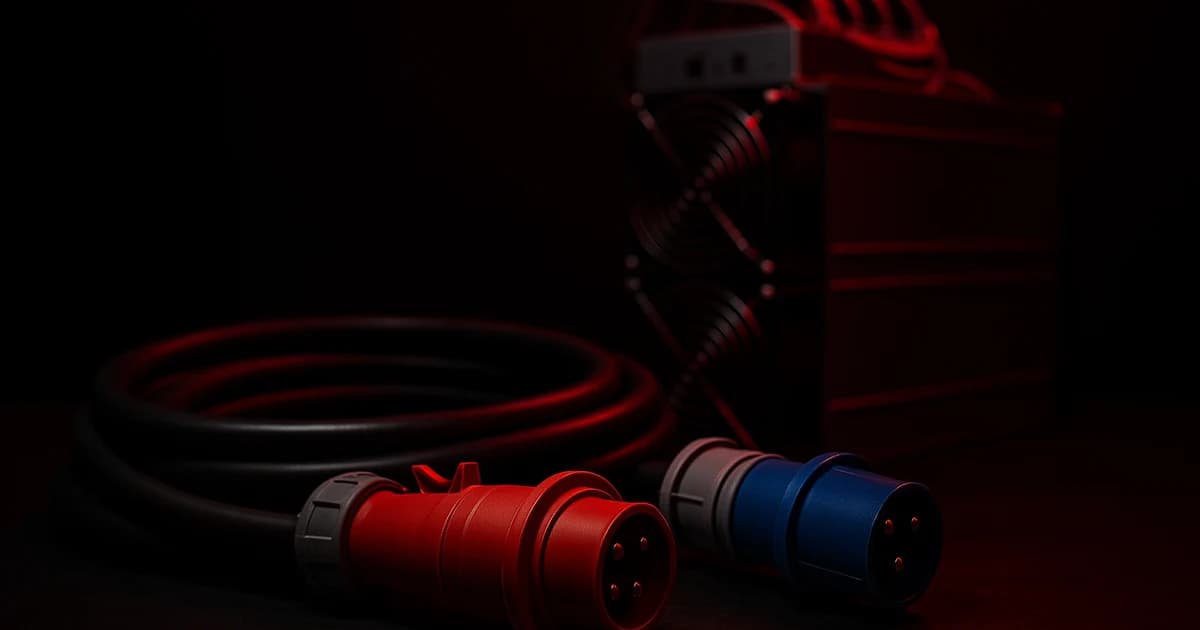
IEC 60309 "commando" connectors are colour-coded and physically non-interchangeable:
- Blue = 200–250V single-phase, 3-pin. A 16A blue gives roughly 3.7kW.
- Red = 380–480V three-phase, 4-pin or 5-pin. A 32A red gives roughly 22kW.
A trap worth knowing before you order: the T21 ships with a proprietary P33-P33 cord, not IEC 60309. It will not fit a standard C19 PDU and needs Bitmain's own ANTPDU adapter. The S23 Hyd 3U uses an LP34 port. The IceRiver KS5L ships without a cord at all. Budget for connectors, and confirm what is in the box.
Inrush current and why your breaker trips
An ASIC's switch-mode PSU draws a large, brief surge at power-on as its capacitors charge. BS EN 60898 breaker curves define the instantaneous magnetic trip band:
- Type B: trips at 3–5× rated current — the default on UK domestic socket circuits
- Type C: 5–10× — suited to higher-inrush equipment
- Type D: 10–20× — for transformers and heavy capacitive loads
A Type B breaker can nuisance-trip on ASIC start-up. The thermal section is near-identical across B, C and D — only the instantaneous band differs, so moving from B to C does not weaken overload protection of the cable.
But do not "just swap in a Type C." Curve selection is tied to earth-fault loop impedance and required disconnection times. It is a design decision for the installing electrician.
Heat: a 3.5kW miner is a 3.5kW heater
All of that power becomes heat — roughly two to three domestic fan heaters running permanently. In a small unventilated room the machine will cook itself.
Published ambient limits vary more than most guides admit, so quote per machine rather than using a blanket figure:
| Miner | Ambient range |
|---|---|
| Antminer S21 / T21 | 0–45°C |
| Antminer L9 | −20 to 45°C |
| ElphaPex DG Home 1 | 0–40°C |
| IceRiver KS5L | 0–35°C |
| FutureBit Apollo III | Not published |
| Antminer S23 Hyd 3U | Inlet coolant 20–50°C (not an air rating) |
The KS5L's 35°C ceiling is the binding constraint in a small room. And note that the S23 Hyd 3U publishes only a coolant temperature — that is not a room rating and should not be read as one.
If heat is the thing putting you off, it can be an asset instead: see mining as home heating.
What genuinely is not feasible at home
Being direct about it:
- Anything three-phase — T21, S23 Hyd 3U, most hydro and immersion units. UK homes are overwhelmingly single-phase, and a DNO three-phase upgrade is a separate and costly application.
- Any 3–3.5kW air-cooled machine without a dedicated notifiable circuit, in a room that cannot shed 3.5kW of heat, at 70–80dB.
- Two full-size miners on one double socket. Ever.
The honest conclusion: the 375–630W class — the Apollo III and DG Home 1 — are genuinely plug-in home products. Everything at 3kW and above is industrial equipment that happens to fit in a box, and it belongs in a facility. That is what our hosting is for: you own the machine, we supply the three-phase, the cooling and the 32A circuits, from $0.014/kWh.
For the quiet-running options specifically, see the silent home mining guide; for what to buy first, the beginner's guide.
No 32A circuit? No three-phase? That's what hosting solves.
Buy the miner, skip the electrician. We supply the power, cooling and connectors from $0.014/kWh — and you keep 100% of the coins.
Safety note: nothing here is a substitute for professional advice. New circuits, breaker curve selection and cable derating are design decisions for a qualified, scheme-registered electrician, and in England and Wales a new circuit must be notified under Part P. Never attempt fixed wiring yourself.
Standards and specifications cited from BS 7671:2018+A4:2026 (IET), UK Government Part P guidance, IEC 60309, and manufacturer specification sheets from Bitmain, IceRiver, ElphaPex and FutureBit, checked August 2026.