

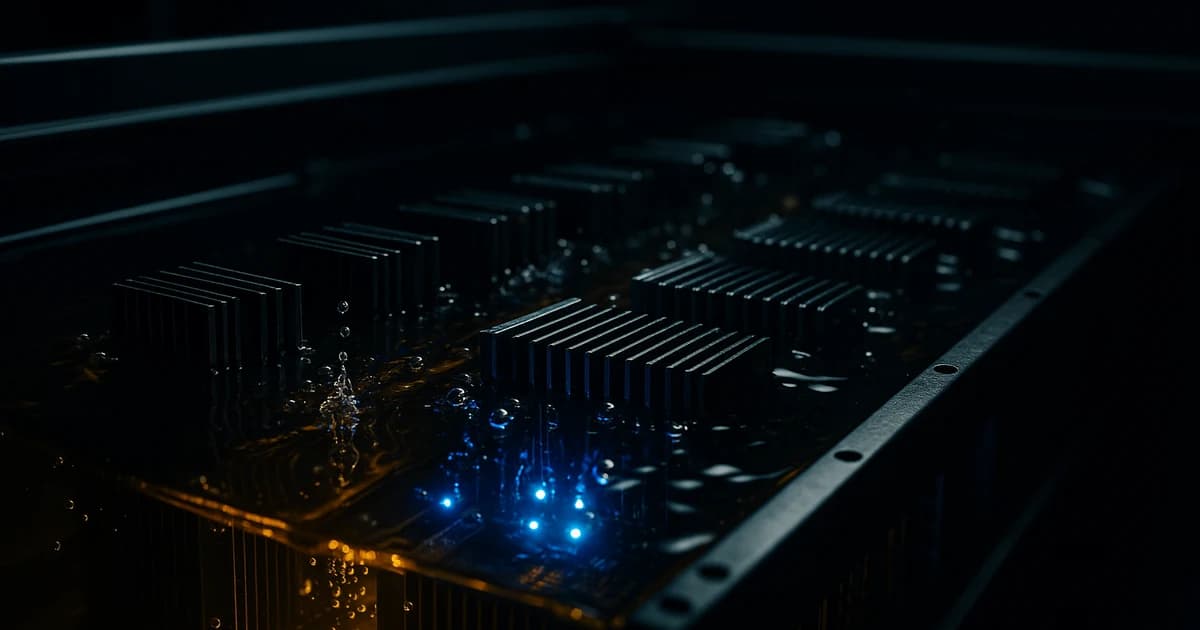
Immersion cooling used to be a fringe experiment. In 2026 it is a shipping product line. Bitmain and Bitdeer both sell miners with "Immersion" or "Hydro" as part of the SKU, factory-tuned for liquid, warranty-covered when used with an approved fluid. This guide is the practical version: what to buy, what it actually costs, and when it beats plain air or a hydro loop.
Written for UK and EU buyers who are past the "should I try mining" question and now want fewer surprises before committing to a tank. If you are still deciding whether to mine at all, read the calculator or the 2026 hardware guide first.
Why immersion at all
Three concrete reasons, in the order operators actually care about them.
Efficiency you can't get from air. A submerged hashboard runs 20–30 °C cooler than a fan-blown one, which lets you run higher clocks with the same silicon. Field results usually land at 15–30 % more hashrate for the same chip, occasionally more on well-binned units with tuned firmware. That gain compounds over the life of the machine.
Noise almost gone. A rack of air-cooled S21s or L9s is 75–80 dB, roughly a chainsaw. Pull the fans, submerge the boards, and the only noise left is a pump and a dry cooler — realistically 35–40 dB. That is what makes immersion possible in outbuildings and near residential zones where air-cooled containers get shut down.
Longer lived hardware. Two of the three most common ASIC failure modes are heat-driven — hashboard chip degradation and fan bearings — and immersion removes both. Operators reporting to Compass, D-Central and MARA consistently cite 2–3× hashboard life for immersed units versus air-cooled equivalents. That is anecdotal in the strictest sense, but the direction is not in dispute.
The 2026 factory-immersion and hydro line-up
These are the current miners engineered from the chip up for liquid, not retrofits. Buy one of these and the manufacturer warranty stays intact if you use an approved fluid.
| Miner | Cooling | Hashrate | Power | Efficiency |
|---|---|---|---|---|
| Bitmain Antminer S23 Immersion (442 Th) | Single-phase immersion | 442 Th/s | 5,304 W | 12 J/TH |
| Bitmain Antminer S21 XP Immersion (300 Th) | Single-phase immersion | 300 Th/s | 4,050 W | 13.5 J/TH |
| Bitmain Antminer S23 Hyd (580 Th) | Hydro (closed loop) | 580 Th/s | 5,510 W | 9.5 J/TH |
| Bitmain Antminer S23 Hyd 3U (1.16 Ph) | Hydro (closed loop) | 1,160 Th/s | 11,020 W | 9.5 J/TH |
| Bitmain Antminer S21e XP Hyd 3U (860 Th) | Hydro | 860 Th/s | 11,180 W | 13 J/TH |
| Bitmain Antminer S21 XP+ Hyd (500 Th) | Hydro | 500 Th/s | 5,500 W | 11 J/TH |
| Bitmain Antminer S21j XP Hyd (495 Th) | Hydro | 495 Th/s | 5,940 W | 12 J/TH |
| MicroBT WhatsMiner M66 Oil-Immersion (280 T) | Single-phase immersion | 280 Th/s | 5,572 W | 19.9 J/TH |
| MicroBT WhatsMiner M7DS (680 Th) | Hydro | 680 Th/s | ~9,180 W | 13.5 J/TH |
| MicroBT WhatsMiner M79S Hydro (1.35 Ph) | Hydro | 1,350 Th/s | 20,000 W | 14.8 J/TH |
| Bitdeer SealMiner A4 Ultra Hydro (886 Th) | Hydro | 886 Th/s | 8,372 W | 9.45 J/TH |
Two useful observations. First, the hydro line-up is deeper than the immersion line-up in 2026 — nine hydro SKUs to three genuine immersion SKUs — because hydro is a lower-CAPEX way to get most of the efficiency win. Second, no factory two-phase immersion SKUs exist any more.
What happened to two-phase
Two-phase immersion — where the fluid boils on the chip and condenses on the tank lid — offered the highest heat flux of any cooling method. It also depended on 3M's Novec fluids. 3M ended PFAS production at the end of 2025, with last order acceptance on 31 March 2025, and no hydrocarbon two-phase fluid has reached commercial qualification since. The market moved wholesale to single-phase, which is what "immersion" now means in practice.
Practical implication: if you are pricing immersion in 2026, you are almost certainly pricing single-phase with a synthetic hydrocarbon or high-grade mineral fluid, an external heat exchanger, and a dry cooler outside. That is the shape of every serious build we quote.
Coolant options that actually matter
Three families dominate:
- Synthetic hydrocarbons (Engineered Fluids BitCool BC-888, ElectroCool EC-100, Shell S3 X). Flash point 195–200 °C, viscosity around 10 mm²/s at 40 °C, biodegradable, insurance-friendly. Bulk pricing lands roughly $11–18/gal at 275-gal tote quantities. This is the safe default.
- GTL / paraffinic (Shell GTL, Ergon HyGold). Similar flash point to BitCool, marginally cheaper, slightly higher viscosity — fine for slower-flow tanks.
- Mineral oil / white oil (Chevron ISO 15, Petro-Canada Purity FG). Cheapest at $4–7/gal but flash point around 150 °C, more oxidation, and increasingly flagged as Class III combustible under NFPA 30. Insurers are starting to say no.
If you are choosing today, pick a synthetic hydrocarbon with a documented approved-fluid confirmation from your miner's manufacturer. Bitmain publishes a short list; using anything not on it voids the immersion warranty.
Tanks, pumps and dry coolers
A working immersion room needs four things beyond the miners themselves.
- The tank — a sealed steel or fibreglass vessel with slot rails, cable pass-throughs, and a fluid manifold. A typical 24-slot single-phase tank holds around 200 gal (800 L) of fluid and dissipates 100–120 kW. Serious tanks are $30,000–$50,000; roughly $1,250–$2,000 per slot.
- CDU or pump + plate heat exchanger — moves warm fluid to the outside world. Off-the-shelf packages run $8,000–$15,000 for the 100 kW class.
- Dry cooler — the outdoor radiator that dumps heat to ambient air. A 120 kW dry cooler is $12,000–$20,000. In hot climates you may need a bigger unit or a partial adiabatic assist.
- Electrical — three-phase panel, PDUs, breakers sized for your specific miner mix. $10,000–$18,000 for a 100 kW room in most EU jurisdictions, more if you are pulling a new service.
Roll it up and a 100 kW immersion room including the miners themselves lands at $430,000–$480,000 all-in — about $4,300–$4,800 per kW. Air-cooled equivalent is $1,800–$3,200 per kW. You buy back the difference in higher hashrate, longer lifespan, and — in tight sites — the fact that immersion was the only way you were getting a permit at all.
Realistic 100 kW immersion CAPEX
| Line item | Cost range (USD) |
|---|---|
| 24-slot single-phase tank + manifold | $30,000 – $50,000 |
| Dielectric fluid (~800 L BitCool BC-888) | $2,400 – $4,000 |
| CDU / pump + plate HX | $8,000 – $15,000 |
| Outdoor dry cooler (120 kW) | $12,000 – $20,000 |
| Electrical (3-ph panel, PDUs, breakers) | $10,000 – $18,000 |
| 20 × Antminer S23 Immersion (~$18k each) | ~$360,000 |
| Install + commissioning | $8,000 – $15,000 |
| All-in (excluding building) | ~$430,000 – $480,000 |
These are indicative numbers a small operator would actually see. Volume buyers and container turnkey providers (Alfa Laval FBOX F40, EZBlockchain, Kryptek) will push all-in closer to $4,300/kW at 250 kW+.
When immersion is worth it — a decision tree
- One miner at home: don't. The tank, fluid and dry cooler CAPEX kills the payback. A single hydro unit like the Antminer S23 Hyd gets you 90% of the benefit for a fraction of the cost, and hosting is cheaper still.
- Small farm, 30–100 kW: viable if power is at or under $0.06/kWh and you can commit to 24/7 uptime. Payback usually lands in 18–24 months.
- Container scale, 100 kW+: immersion is often the right answer, especially in hot or dusty climates, or on sites with strict noise ordinances. If your site is cold and quiet, hydro at lower CAPEX may still win.
- Very cold climate: air is still cheapest. Iceland-style sites don't need immersion to keep chips happy.
If you are unsure which side of the line you sit on, run the numbers with the actual miners on our profitability ranking — it recalculates payback against every one of our facility rates.
Immersion versus hydro versus air
| Air-cooled | Hydro (closed loop) | Single-phase immersion | |
|---|---|---|---|
| Typical efficiency gain | baseline | +10–15% | +15–30% |
| Noise | 75–80 dB | ~50 dB | ~35–40 dB |
| CAPEX per kW | $1.8k–3.2k | $2.5k–3.8k | $4.3k–4.8k |
| Dry cooler needed | No | Yes | Yes |
| Fluid handling | None | Small closed loop | Tank of dielectric |
| PUE (typical) | 1.4–1.6 | 1.15–1.25 | 1.02–1.10 |
| Hashboard lifespan | baseline | +30–60% | 2–3× reported |
Hydro is the pragmatic middle. If you already run water, or if you want quieter and more efficient than air without committing to a tank of oil, machines like the S21 XP+ Hyd and S23 Hyd are where the market has consolidated. Immersion wins on absolute efficiency, silence, and hardware longevity — and pays for those wins in CAPEX.
Gotchas that will bite you
- Warranty voidance. Submerging a standard air-cooled miner voids Bitmain and MicroBT warranty. Only factory Immersion or Hyd SKUs preserve cover, and only with an approved fluid.
- PSU sealing. Retrofits need conformal coat and connector seal. Factory-immersion PSUs are already sealed; do not swap them out for stock air PSUs.
- Gaskets and plastics. Silicone and some EPDM parts swell in certain hydrocarbons. Viton (FKM) is the safer choice for O-rings.
- Fans and labels. Remove the fans before dunk, or they will float, disconnect and lodge somewhere expensive. Peel or seal any paper labels — adhesives contaminate fluid fast.
- Fluid disposal. Used dielectric is regulated. In the UK it falls under the Hazardous Waste Regulations; in the EU under Directive 2008/98/EC. Budget for scheduled removal.
- Insurance. Most industrial policies now demand flash point ≥ 200 °C and secondary containment. Cheap mineral oils are increasingly uninsurable at scale.
Factory immersion versus retrofitted air
A retrofitted air miner in a tank works, but you leave 2–3 J/TH on the table to residual air pockets, unsealed components, and firmware that was tuned for a fan curve rather than a fluid temperature curve. Factory immersion units — the S23 Immersion, the S21 XP Immersion, the M66 oil-immersion — ship without fans, with immersion-rated PCB conformal coating, sealed connectors, and firmware that tracks oil temperature. They hit their spec efficiency; retrofits usually don't.
Where hydro fits, briefly
Hydro uses a cold plate on the hashboard and moves heat via a closed water loop to an outdoor dry cooler. Nothing is submerged. CAPEX is 30–50% below immersion, noise is around 50 dB (louder than immersion, much quieter than air), and efficiency lands 10–15% ahead of the air equivalent. For most mid-scale operators this is the sensible starting point. The full 2026 Bitmain range lives in the Antminer range guide; the equivalent MicroBT models are in the WhatsMiner guide.
FAQ
Is immersion cooling worth it for a single home miner?
No. The tank, fluid and dry cooler cost more than the miner itself, and you never earn the CAPEX back at a single-unit scale. A factory hydro miner into a small closed loop is the closer answer for one machine; hosting is usually cheaper still.
What is the cheapest way to try immersion?
A used single-phase 6- or 12-slot tank with a small dry cooler and mineral oil can be built for under $8,000 excluding miners. Just accept that mineral oil restricts your insurance options and that you are voiding manufacturer warranties if you submerge air-cooled units. Most operators who start there later move to synthetic hydrocarbon fluid and factory-immersion SKUs.
How much hashrate gain should I expect from immersion?
15–30% on a well-binned modern chip with a tuned firmware. Some operators quote higher; those numbers usually involve aggressive overclocks that shorten hardware life. Below 15% and something is wrong — usually a coolant flow rate that is too low or a dry cooler that is undersized for the ambient conditions.
What is the difference between immersion and hydro cooling?
Immersion submerges the whole hashboard in dielectric fluid. Hydro pipes water through a cold plate that sits on top of the hashboard, with nothing submerged. Immersion is quieter, more efficient, and more capital intensive. Hydro is a smaller build with most of the benefit.
Does immersion cooling void the Bitmain warranty?
Only if you submerge a machine that was not sold as an immersion SKU, or if you use a fluid that is not on Bitmain's approved list. Buy an S23 Immersion or S21 XP Immersion and use a listed fluid and the warranty is intact.
What is single-phase versus two-phase immersion?
Single-phase pumps fluid across the boards without a phase change and rejects heat via an external heat exchanger. Two-phase relied on the fluid boiling on the chip and condensing on the tank lid; it required 3M Novec, which was withdrawn in 2025. In 2026 there is no serious two-phase market for Bitcoin miners.
What temperature should the fluid run at?
Most Bitmain-approved profiles target 40–55 °C fluid inlet and 55–65 °C outlet. Higher inlet costs efficiency; lower inlet costs dry cooler CAPEX. A good design sits in the middle and adjusts by season.
Can I move an immersion tank between sites?
Yes, but drain the fluid first, log the drain volume, and re-fill on site. Shipping a full tank is a mess and usually a liability issue with the courier.
Skip the tank build — host with us instead
Our facilities already run S23 Hydro, S21 XP+ Hyd and S23 Immersion racks on power from $0.014/kWh. You buy the miner, we run it, you keep 100% of the coins.
Read next: the 2026 Bitcoin hardware guide, the full Bitmain range or the 2026 mining hardware market report. Figures are accurate as of August 2026 and will move as fluid prices, hashprice and difficulty change.