

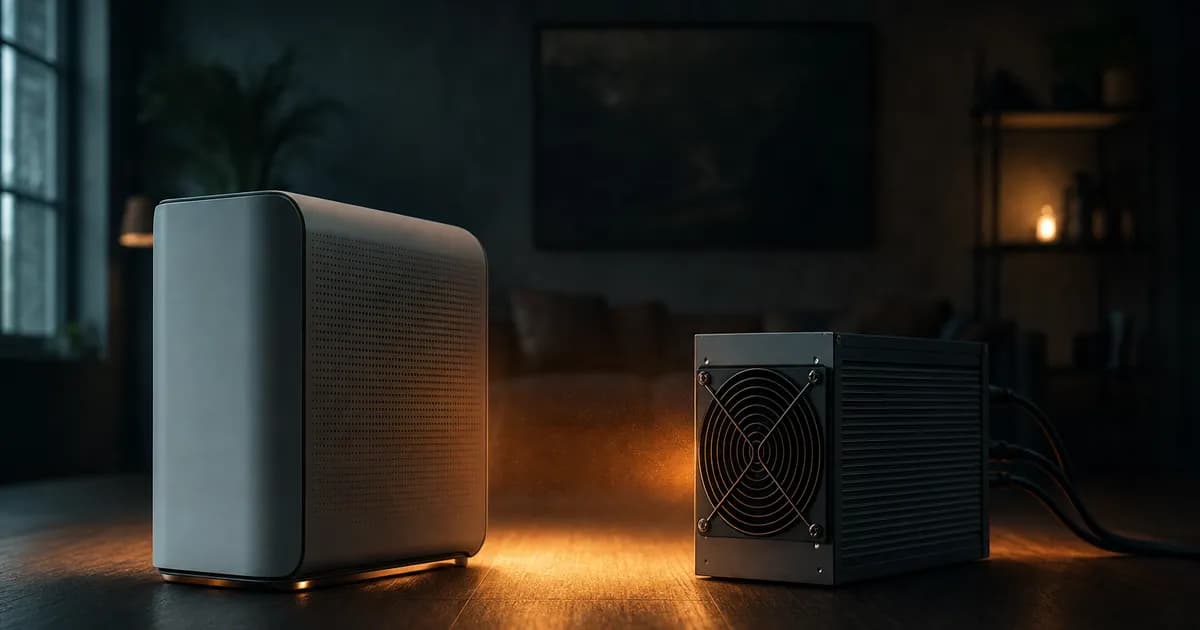
Short answer: the Fluminer T3 earns more: 115 TH/s at 1,700 W (14.8 J/TH) against the Avalon Q's 90 TH/s at 1,674 W (18.6 J/TH), for about 28% more revenue on almost the same power. The Avalon Q is the easier home machine: quieter, Wi-Fi and app control, heater modes. On EU household electricity, neither one makes a profit on its own; both earn properly only on hosted power.
Both are the two home Bitcoin miners people compare most in 2026. "Avalon Q vs Fluminer T3" is the top autocomplete suggestion in both directions. Figures below use network data from 9 November 2026: hashprice $31.62 per PH/day (Hashrate Index), BTC ≈ $74,100.
Spec sheet side by side
| Canaan Avalon Q | Fluminer T3 | |
|---|---|---|
| Hashrate (max mode) | 90 TH/s | 115 TH/s |
| Power | 1,674 W | 1,700 W |
| Efficiency | 18.6 J/TH | 14.8 J/TH |
| Noise | ~45 dB (rated) | Louder fans; varies by mode |
| Connectivity | Wi-Fi + app, Ethernet | Ethernet only |
| Heater use | Built-in heater-style modes | Works as a heater, no dedicated modes |
| Algorithm | SHA-256 (BTC) | SHA-256 (BTC) |
| Our price (Nov 2026) | $1,160 | $837 |
| Price per TH | $12.9 | $7.3 |
Spec figures from manufacturer listings via ASIC Miner Value; prices from our store on 9 Nov 2026.
What each one earns
Revenue is hashprice × hashrate: about $3.64/day for the T3 and $2.85/day for the Avalon Q. Profit depends entirely on your power price:
| Electricity price | Avalon Q net/day | Fluminer T3 net/day |
|---|---|---|
| Hosted, $0.015/kWh | +$2.24 | +$3.02 |
| $0.05/kWh | +$0.84 | +$1.60 |
| €0.10/kWh (≈$0.112) | −$1.65 | −$0.93 |
| €0.20/kWh (≈$0.224) | −$6.15 | −$5.50 |
| €0.30/kWh (≈$0.336) | −$10.65 | −$10.07 |
Break-even electricity price: T3 ≈ $0.089/kWh, Avalon Q ≈ $0.071/kWh. The EU household average is about €0.28/kWh, so at home both machines cost more in power than they mine. Simple payback on hosted power at our prices: T3 ≈ 9 months, Avalon Q ≈ 17 months, assuming today's hashprice holds.
The honest way to look at home mining: a heater with a rebate
Both machines turn every watt into heat, just like an electric heater. If you would run a 1.7 kW electric heater anyway, mining income reduces your heating cost:
- Fluminer T3: $3.64/day of BTC over 40.8 kWh, which knocks about $0.089 off every kWh of heat.
- Avalon Q: $2.85/day over 40.2 kWh, a discount of about $0.071 per kWh.
That is the real home case: cheaper heating in winter, not profit. In summer, when you don't want the heat, either machine just loses money at home. Our Bitcoin heater guide covers this in detail.
Practical differences that matter at home
Noise. The Avalon Q was designed for living spaces and is rated around 45 dB, roughly a quiet fridge. The T3 runs its fans harder to move 1.7 kW of heat out of a smaller body, and owners describe it as noticeably louder. In a bedroom or office, the Q wins.
Setup. The Q pairs over Wi-Fi with a phone app. The T3 needs an Ethernet cable and a browser dashboard.
Power socket (230 V). At about 1.7 kW, both draw roughly 7.4 A on a 230 V circuit, within a standard EU or UK socket. Don't share the circuit with a kettle or oven, and avoid extension reels. One hands-on review of the T3 reported reboots in high-power mode on a regular outlet. Use a dedicated circuit if you can (see powering an ASIC miner in the UK and EU).
Buying safely. Fluminer's popularity has attracted clone websites. At least one lookalike domain has a string of non-delivery reviews on Trustpilot. Buy from an established reseller, never pay by irreversible crypto to an unknown site, and read how to spot fake ASIC shops.
Verdict
| If you want… | Choose |
|---|---|
| The most BTC per euro spent | Fluminer T3: $7.3/TH and 14.8 J/TH |
| A quiet miner in a lived-in room | Avalon Q |
| Plug-and-play setup (Wi-Fi, app) | Avalon Q |
| Actual profit rather than discounted heating | Either, hosted; the T3 pays back about twice as fast |
If you are not going to use the heat, neither machine belongs on a home tariff. Hosting either one in our facilities turns the same hardware into a positive daily earner. To compare against full-size machines, see the 5 best Bitcoin miners under $1,000.
Mining income is not guaranteed and moves with Bitcoin's price and network difficulty. Figures as of 9 November 2026.