

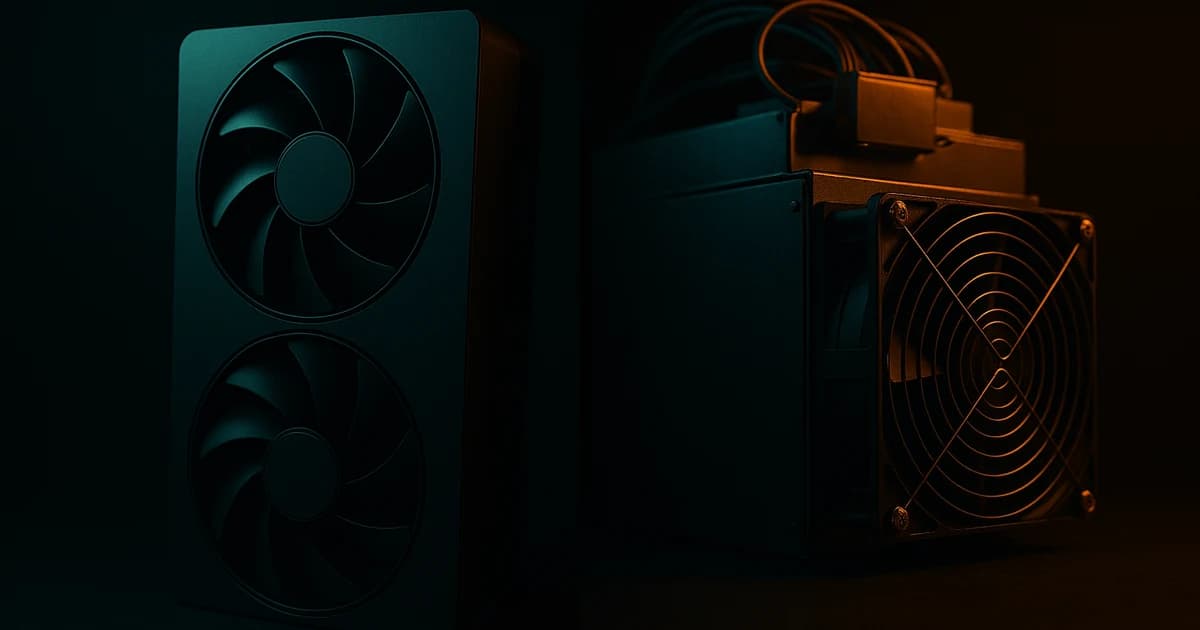
Here is the comparison that ends the argument, and it is not close enough to need a second look.
An RTX 4090 — a £1,500 flagship graphics card — runs SHA-256 at 1.8 Gh/s. An Antminer S21 XP runs it at 270 Th/s. That is 150,000 times more hashrate, and the efficiency gap is wider still: about 13.5 joules per terahash against roughly 139,000. The ASIC is ten thousand times more efficient at the identical task.
In revenue terms, that 4090 mining Bitcoin earns about $0.00007 a day — seven thousandths of a cent — while burning $0.48 of electricity. You would need roughly 143 of them running flat out to earn one cent of Bitcoin per day.
So: you cannot mine Bitcoin with a GPU in 2026. Not "inefficiently" — not at all. But that is only half the question, because GPUs can still mine something, and the honest comparison is more interesting than the headline. Figures verified against Minerstat benchmarks and on-chain data in September 2026.
Why the gap is so enormous
A GPU is a general-purpose parallel processor. It has 16,384 CUDA cores that can run graphics, physics, AI inference or a hash function — and all the silicon that makes that flexibility possible is dead weight when you only ever want one operation.
An ASIC is the opposite bargain. Bitmain's BM1370 chip can do exactly one thing — SHA-256 — and every transistor is spent doing it. No scheduler, no memory controller for textures, no video encoder. That is where four to five orders of magnitude come from: not better engineering, but the removal of everything you are not using.
The corollary is the trap. An ASIC is worthless the moment its coin stops being worth mining, while a GPU can be sold to a gamer. That resale floor is the single strongest argument for GPUs, and we come back to it at the end.
What a GPU actually earns in 2026
Minerstat benchmarks the RTX 4090 across 34 algorithms. Here is what it earns on the ones that matter, at $0.08/kWh:
| Card | Best coin | Gross/day | Profit/day | Break-even $/kWh |
|---|---|---|---|---|
| RTX 4090 (320 W) | EPIC-ProgPow | $1.91 | $1.28 | $0.25 |
| AMD RX 7900 XTX | EPIC-ProgPow | — | $1.06 | — |
| RTX 4080 | EPIC-ProgPow | — | $0.94 | — |
| RTX 4070 Ti Super | EPIC-ProgPow | — | $0.78 | — |
| RTX 4070 Ti | EPIC-ProgPow | — | $0.65 | — |
A flagship GPU nets about $1.28 a day. Over a year that is $467, against a card costing £1,500 or more — a payback north of three years on hardware that will be two generations old by then, assuming the coin survives, which is a real assumption: the 7-day range on that figure was $0.53 to $2.30, a four-fold swing in a week.
The break-even is genuinely good, though. At $0.25/kWh a 4090 still clears its electricity — which is better than any Bitcoin ASIC manages, and better than most European domestic tariffs. That is the one real advantage GPUs retain, and it comes from the coins they mine being small and lightly contested rather than from the hardware being good.
Head to head on the same algorithm
The fairest test is to point both at the identical coin. Kaspa has both ASICs and GPU miners, so:
| Hardware | Kaspa hashrate | Revenue/day | Ratio |
|---|---|---|---|
| Antminer KS7 (45 Th) | 45 Th/s | $8.93 | — |
| AMD RX 7900 XTX | ~1.4 Gh/s | $0.00014 | 63,800× worse |
Same coin, same algorithm, same day. The GPU earns fourteen thousandths of a cent. This is what "ASIC-resistant" means in practice once an ASIC exists: the algorithm remains technically GPU-mineable and economically closed. Our algorithms guide traces how every ASIC-resistant design eventually fell the same way.
So what can a GPU still mine?
Only coins where no ASIC exists yet — which is a moving and shrinking target. In September 2026 the profitable options on a 4090 are EPIC-ProgPow, Ryo and GLINK, with IronFish, Pyrin and TON also benchmarked highly.
What they have in common is the problem: they are small. Low liquidity means you may not be able to sell what you mine at size, and — the pattern that repeats — the moment one becomes valuable enough to matter, somebody builds an ASIC for it and GPU miners are pushed out within months. Ethash is the cautionary case: billions of dollars of GPU capacity made obsolete overnight when Ethereum moved to proof-of-stake in September 2022, and the ASICs that had arrived in 2018 had already taken the margin before that.
A GPU miner is therefore running a perpetual switching operation — chasing whichever small coin is briefly best, as Minerstat's own "worth switching?" tooling implies. That is a hobby with real skill in it. It is not a passive income stream.
The honest scorecard
| GPU | ASIC | |
|---|---|---|
| Can mine Bitcoin | No — 150,000× too slow | Yes |
| Earnings per unit | ~$1.28/day best case | $7.88–$45.71/day |
| Coin flexibility | Excellent — 34 algorithms | One algorithm, permanently |
| Break-even power price | ~$0.25/kWh | $0.12/kWh or lower |
| Resale if mining ends | Sells to gamers | Scrap value |
| Noise | ~35–45 dB | 75 dB (35 dB for home units) |
| Other uses | Gaming, AI, video | None |
Read that table properly and the answer stops being "ASICs win" and becomes "they are different instruments". The ASIC is a specialised income machine with a terminal value near zero. The GPU is a general-purpose asset that happens to mine, with a resale market and a fallback career in gaming or AI workloads.
What we would actually tell you
If you want to mine Bitcoin: buy an ASIC, and the decision is entirely about your electricity price rather than the machine. Our buyer's guide covers the current range; the hashprice guide explains exactly what a terahash earns and why. There is no GPU path to Bitcoin at any scale, any power price, or any card.
If you already own a gaming GPU and pay under about 25 cents a kilowatt-hour, mining it during idle hours is a legitimate way to recover a little of its cost. Treat $1 a day as the realistic figure, expect to switch coins, and do not buy more cards on the strength of it.
If you are choosing what to buy today for mining income: a GPU's $1.28 a day against an Antminer S21's $7.88 gross is not a close comparison, and the ASIC's problem — domestic electricity — is solvable by putting the machine somewhere the power is cheap. That is what hosting is for, and our home versus hosted comparison runs both cases.
If what you actually want is flexibility and a resale floor, the GPU is the honest choice and always has been — just go in knowing you are buying an asset that mines, not a mining asset.
Whichever way you lean, put your real electricity rate into the profitability model first. Between 8 cents and 25 cents this entire comparison changes shape.
Sources: Minerstat hardware benchmarks for the RTX 4090, RTX 4080, RTX 4070 Ti/Ti Super and RX 7900 XTX (benchmark set dated 29 August 2026) including per-algorithm hashrate, power draw and electricity-sensitivity figures; Minerstat Kaspa hardware ranking for the KS7 and RX 7900 XTX comparison; on-chain network data via mempool.space for the Bitcoin revenue rate. GPU profitability is highly volatile — the RTX 4090's own 7-day range was $0.53 to $2.30 per day. Our product pages and profitability ranking run on the site's standing model rate, which may differ from spot. Mining income is never guaranteed.