

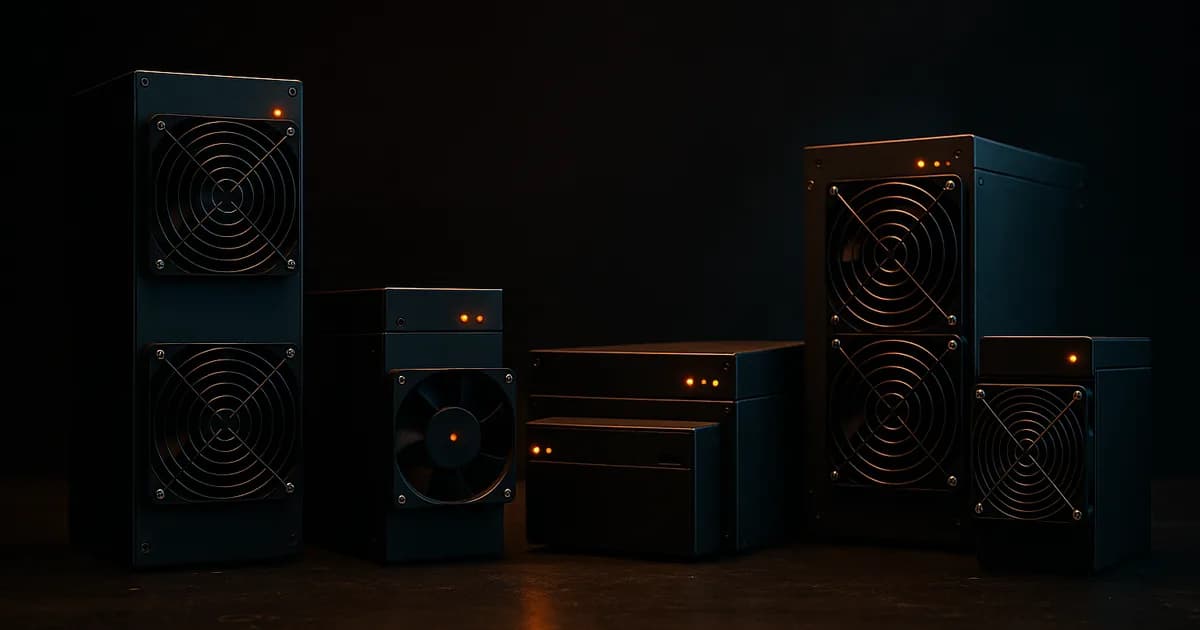
Bitmain builds ASICs where the market is big enough to justify a chip tapeout — Bitcoin, Scrypt, and eventually Kaspa. iBeLink built chips for Kadena and Nervos, chains Bitmain never touched. That is the whole proposition: iBeLink makes the hardware nobody else bothers to make, and on several algorithms its machines are the only serious option that exists.
The company shipped the world's first X11 ASIC in March 2016 and has since taped out silicon for seven different algorithms. This guide covers the full range, decodes the confusing model names, and gives honest numbers on the one model most people are searching for — the BM-KS Max.
Who iBeLink is
iBeLink is a Chinese ASIC manufacturer backed by Tiannengbo Group. Its DM384M, shipped in early 2016, was genuinely the first Dash X11 ASIC on the market — a first-mover claim that stands up to checking, unlike most in this industry.
Across a decade it has shipped hardware for X11 (Dash), Blake256R14 (Decred), Blake2B-Sia (Siacoin), Blake2S (Kadena), Eaglesong (Nervos CKB), kHeavyHash (Kaspa) and Scrypt. Where iBeLink genuinely leads today is Siacoin: the BM-S3+ and BM-S3 hold the two most efficient positions on Blake2B-Sia, ahead of everything Goldshell has built.
One honest caveat. iBeLink's product cadence has clearly slowed. Its own site still carries a 2024 copyright footer and banners advertising "the most profitable miner of 2024", and nearly every model shows as sold out. The newest release on record is the BM-S3+ from April 2025. Treat this as a mature line-up from a company that has slowed down, not a defunct one — but do check availability and warranty terms before committing.
Decoding iBeLink model names
This trips up more buyers than anything else in the range, because two of the prefixes differ by a single letter and mine completely different coins.
| Prefix | Coin | Algorithm | Models |
|---|---|---|---|
BM-K | Kadena | Blake2S | K1, K1+, K1 Max, K3, K3 Max, K3 Mini |
BM-KS | Kaspa | kHeavyHash | KS Max only |
BM-S | Siacoin | Blake2B-Sia | S1, S1 Max, S3, S3+ |
BM-N | Nervos CKB | Eaglesong | N1, N3, N3 Max, N3 Mini |
BM-L | Litecoin / Doge | Scrypt | L3 |
DM | Dash | X11 | DM384M, DM11G, DM22G, DM56G |
DSM | Decred | Blake256R14 | DSM6T, DSM7T |
The single letter S is the only thing separating Kadena from Kaspa. A BM-K3 is a Kadena machine; a BM-KS Max is a Kaspa machine. They are not variants of each other.
The tier ladder runs base → Plus or + → Max, with Mini denoting a sub-300 W desktop unit. iBeLink has never used "Pro" — if you see an "iBeLink Pro" listed anywhere, it does not exist. For the same reason, iBeLink has never made a Handshake, Grin or Blake3 miner; the Handshake HS3 people sometimes attribute to iBeLink is a Goldshell product.
The full iBeLink range in 2026
Specifications from ASIC Miner Value. Only three of these are realistically buyable new in 2026 — the BM-KS Max, BM-S3 and BM-K3 Max. The rest are secondary-market or legacy.
| Model | Coin | Hashrate | Power | Efficiency | Released |
|---|---|---|---|---|---|
| BM-S3+ | Siacoin | 25 Th/s | 3,400 W | 136 J/Th | Apr 2025 |
| BM-S3 | Siacoin | 19 Th/s | 3,100 W | 163 J/Th | Mar 2024 |
| BM-K3 Max | Kadena | 82 Th/s | 3,200 W | 39 J/Th | Jan 2024 |
| BM-K3 | Kadena | 70 Th/s | 3,300 W | 47 J/Th | Dec 2022 |
| BM-N3 Max | Nervos | 30 Th/s | 3,300 W | 110 J/Th | Apr 2024 |
| BM-N3 | Nervos | 25 Th/s | 3,300 W | 132 J/Th | Dec 2022 |
| BM-KS Max | Kaspa | 10.5 Th/s | 3,400 W | 324 J/Th | Feb 2024 |
| BM-S1 Max | Siacoin | 12 Th/s | 3,150 W | 263 J/Th | May 2022 |
| BM-L3 | LTC / Doge | 3.2 Gh/s | 3,000 W | 938 J/Gh | Nov 2024 |
| DM56G / DM22G | Dash | 56 / 22 Gh/s | 2,100 / 810 W | 37.5 / 36.8 J/Gh | 2017–18 |
iBeLink BM-KS Max: the Kaspa numbers
The BM-KS Max delivers 10.5 Th/s at 3,400 W, running kHeavyHash across four fans at 75 dB. It measures 424 × 289 × 388 mm at 12.2 kg and also mines Sedra and Bugna.
Kaspa's network as of early August 2026: KAS trades around $0.025–$0.026, network hashrate sits near 313–323 PH/s, and difficulty around 31.5 P. For context, Kaspa is roughly 87% below its all-time high and network hashrate has fallen from about 710 PH/s a year ago.
The machine mines roughly 55–60 KAS per day, worth about $1.40–$1.75 gross. Sources disagree by around 20% on small-cap revenue, so treat that as a range rather than a figure.
| Power price | Electricity/day | Profit/day |
|---|---|---|
| $0.02/kWh | $1.63 | −$0.23 to +$0.12 |
| $0.10/kWh | $8.16 | −$6.40 to −$6.80 |
Break-even electricity is roughly $0.017–$0.021/kWh — under two cents. That is the single most important number on this page.
We are not going to publish a payback figure, because there honestly isn't one at current Kaspa prices. Even with free electricity, $1,799 divided by $1.45/day is about 3.4 years — and that assumes KAS does not fall further. Any site quoting you an eight-month ROI on this machine is multiplying optimistic numbers together.
BM-KS Max vs the Kaspa competition
All prices below are live stock on this site, so you can check them yourself.
| Miner | Th/s | Watts | J/Th | Price | $/Th |
|---|---|---|---|---|---|
| Antminer KS7 (45Th) | 45 | ~3,400 | 77 | $1,682 | $37 |
| IceRiver KAS KS7 (30Th) | 30 | 3,500 | 117 | $1,232 | $41 |
| IceRiver KS7 Lite (4.2Th) | 4.2 | 500 | 119 | $638 | $152 |
| IceRiver KS5M (15Th) | 15 | 3,400 | 227 | $560 | $37 |
| iBeLink BM-KS Max | 10.5 | 3,400 | 324 | $1,799 | $171 |
| Goldshell E-KA1M | 5.5 | 1,800 | 327 | $1,029 | $187 |
We will be blunt: if your goal is Kaspa profit, the BM-KS Max is not the machine to buy. The Antminer KS7 is about 4.2 times more efficient and 4.6 times cheaper per terahash, and we stock it for less money. The BM-KS Max's honest case is brand loyalty, single-unit simplicity, and a 3,400 W footprint that drops straight into a rack slot sized for the IceRiver units it replaces.
For the wider Kaspa hardware picture, see our IceRiver range guide and the Goldshell guide.
Why mine a niche coin at all?
There is a real argument here, and it deserves a fair hearing before the counter-argument.
The case for: fewer competitors per unit of hashrate — a 30 Th/s Nervos machine is a meaningful share of a small network, whereas 300 Th/s of SHA-256 is a rounding error on Bitcoin. Difficulty rises more slowly after you deploy. And with no ASIC competitor on the algorithm, there is no risk of a rival shipping a 4× more efficient chip and obsoleting your machine overnight. Some miners treat niche hardware as a leveraged, dollar-cost-averaged long position on a chain they believe is undervalued.
The case against, using iBeLink's own catalogue as the example. Kadena currently trades near $0.0039 with a market cap around $1.3M and roughly $4,890 of daily volume. The BM-K3 Max is the best Kadena machine ever built at 39 J/Th — and it earns about $1.17/day, losing over $4/day at $0.07/kWh. Best-in-class silicon, dead chain economics. That is the entire risk in one row.
The specific dangers worth naming: illiquidity — at a few thousand dollars of daily volume, selling a month's output moves the price against you, so paper revenue is not realisable revenue. Resale collapse — niche ASICs are non-fungible, and an IceRiver KS5L that launched in the thousands now sells for $499. Single-algorithm lock-in — these are fixed-function chips; if the chain dies or changes its proof-of-work, the machine is scrap.
The honest framing: buy niche hardware only if you would be content holding the coin at zero, you have sub-two-cent power, and the capital is money you can write off.
Which iBeLink suits whom
- Siacoin miners: the BM-S3 or BM-S3+ — genuinely the best Blake2B-Sia hardware anyone makes, and the clearest reason to buy iBeLink.
- Kaspa believer with sub-2c power wanting one simple box: the BM-KS Max, knowing it is the least efficient Kaspa unit we stock.
- Kaspa buyer optimising returns: not iBeLink — buy the Antminer KS7 instead.
- Kaspa buyer on a small budget: the IceRiver KS5M or KS7 Lite, the latter at 500 W being genuinely home-viable.
- Kadena speculator: the BM-K3 Max, eyes fully open — it is unprofitable at any realistic power price today.
- Dash or Decred: nothing current. Those units are 2017–18 legacy hardware.
Sub-2c power is the only way this works
The BM-KS Max breaks even between $0.017 and $0.021/kWh. Our hosting starts at $0.018/kWh — inside that band — and you keep 100% of the coins. We would rather show you the maths than promise you a return.
Browse the full miner range, or run your own figures on the mining calculator. All network data accurate as of 5 August 2026; small-cap coin prices move fast, so re-check before buying.